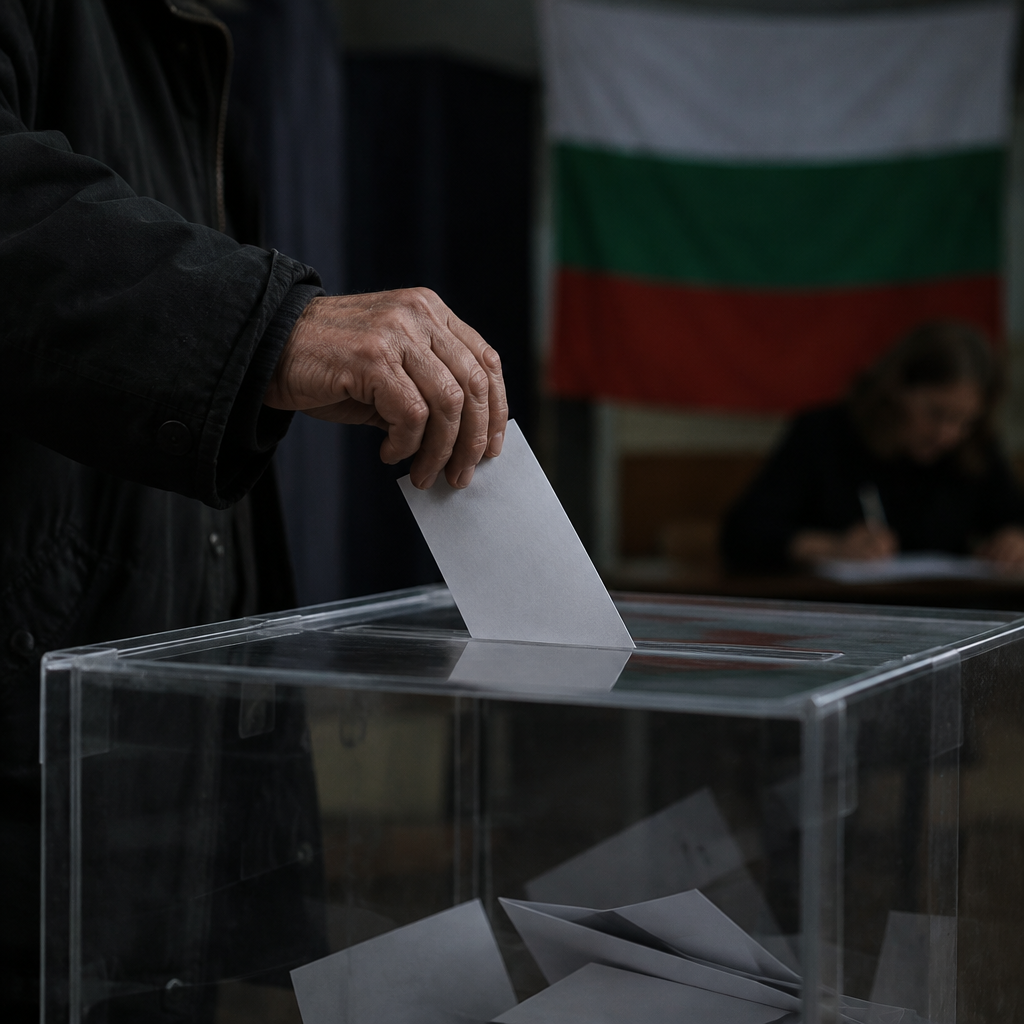
Yotova Wins Bulgaria's Presidency: A 'President of Peace' and a Country Split in Two
Iliana Yotova took 57.6% of the runoff to become Bulgaria's first elected female president, campaigning against military aid to Ukraine and for dialogue with Moscow. Her victory is a foreign policy verdict delivered by a third of the electorate.
Iliana Yotova won Bulgaria's presidential runoff on Sunday with 57.6% of the vote against 39.5% for Andrey Gyurov, becoming the first woman elected to the post. She had already been serving as acting president since Rumen Radev stepped down to become prime minister earlier this year. On paper it is a decisive mandate. In practice it was delivered by fewer than three in ten eligible voters.
The campaign was a referendum on the war
Radev framed the runoff explicitly: "We are choosing between war and peace." Yotova ran as the "president of peace," told a rally on 6 October that "not a single Bulgarian soldier will go to Ukraine," and described her opponents as warmongers. She did not name Russia as the aggressor. In a podcast interview two days before the vote she said: "Russia is by no means an enemy of Bulgaria. Russia is part of our history, and I very much hope that it will be a key factor in the future security architecture across Europe, including for us."
Gyurov, a former caretaker prime minister whom Yotova herself appointed in February, had signed a security cooperation agreement with Ukraine in March. That signature became the central attack line against him.
The arithmetic that produced the result
The first round was much tighter than polling suggested: Yotova took 34.8%, Gyurov 31.95%, forcing a runoff. Kostadin Kostadinov of the nationalist Vazrazhdane party came third with 12.5%, and roughly 70% of his voters moved to Yotova in the second round, according to the pollster Dimitar Ganev of Trend.
Most opposition parties, including Boyko Borisov's GERB, declined to field a candidate at all. That abstention, combined with turnout below 30%, is what turned a divided country into a lopsided headline number.
Two Bulgarias, not one
The geographic and generational split is stark. Voters aged 18 to 40 backed Gyurov. Voters over 40 backed Yotova. Gyurov dominated Sofia; Yotova dominated smaller regional cities, towns and villages. This is the same urban-rural and young-old fault line running through most of the continent, now mapped onto the question of whether Russia is an enemy.
The Black Sea is the backdrop
The vote came weeks after drones struck several ships in the Black Sea off the Bulgarian coast. The European Council blamed Russia for the escalation, and the European Parliament called on the EU and member states to consider deploying a naval operation there. Radev's response was to summon the Russian ambassador and observe that "logic suggests that the outcome" of the attacks "is to the advantage of the Russian Federation." Days before the runoff he noted that two ships had been struck in Romanian territorial waters, after Romania had held Russia responsible, and remarked that "many people think that once the aggressor is identified, the attacks will stop."
That drew criticism in Bucharest. It is also the clearest illustration of the governing style Bulgarians have now endorsed: never assign responsibility, always invoke peace, and let the ambiguity do the work.
What it does and does not change
The Bulgarian presidency is largely ceremonial. Constitutionally, only parliament can send troops abroad or declare war, which makes Yotova's central campaign promise legally hollow. Analysts including Ganev see no threat to Bulgaria's EU and NATO orientation: over two-thirds of Bulgarians do not question it, and around two-thirds view the EU positively.
But the office has a megaphone, and Bulgaria now has a prime minister with an absolute majority and a president from the same party, both arguing against military aid to Kyiv and both urging engagement with Vladimir Putin. In a European Council that still decides sanctions and Ukraine financing by unanimity, that voice matters even when the vote does not.
The pattern worth naming
In the final days, Yotova's supporters circulated claims that the opposition was preparing a "Maidan" to overturn the result. Similar claims were made by Viktor Orban before this year's Hungarian election and by Aleksandar Vucic before Serbia's. The playbook has become regional: cast the contest as war versus peace, win the nationalist vote, then pre-emptively delegitimise the result you expect to lose.
Bulgaria chose. What it chose is less clear than the percentage suggests.
Study Tips & Discussion
(0)Log in to join the discussion.
No comments yet — be the first to share your thoughts!
More in Geopolitics & Security
Related Articles

A Russian Network Posed as Western Media During France's Riots. MAGA Accounts Got 17 Times the Reach
7 min read
Days After the Blue Wave, G7 Allies Get Their First Look at Trump's America
7 min read

Europe Gets a Congress It Did Not Vote For and Cannot Count On
5 min read