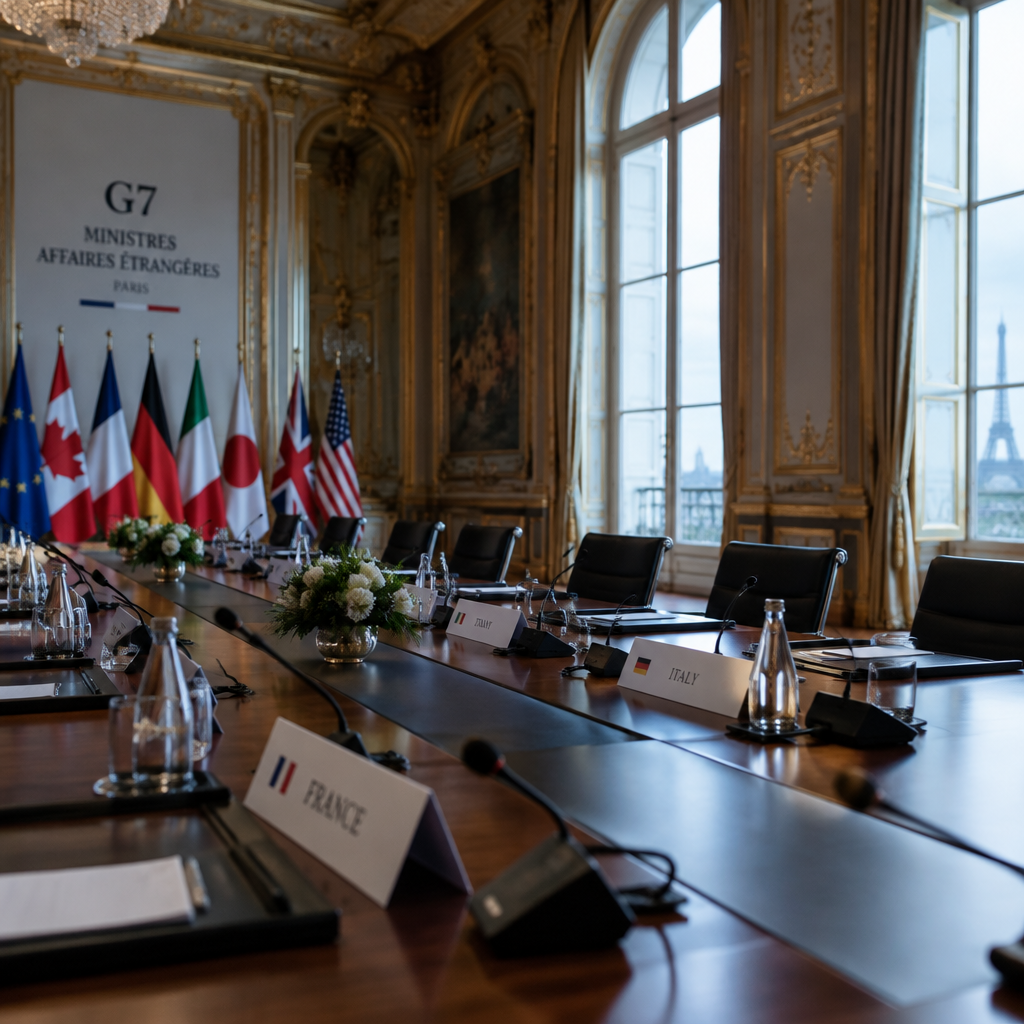
Days After the Blue Wave, G7 Allies Get Their First Look at Trump's America
G7 foreign ministers meet in Paris on Monday and Tuesday, moved at short notice from Marseille for security reasons after weeks of French protests. It is Marco Rubio's first appearance before allies since the Democrats took both chambers of Congress, and the first chance for Europe to test whether a wounded president changes course on Ukraine.
G7 foreign ministers meet in Paris on Monday and Tuesday for their second formal two-day meeting of the French presidency, and the setting itself is the story: the gathering was moved at short notice from Marseille to Paris for security reasons, after weeks of demonstrations across France that have drawn tens of thousands into the streets and forced about 70,000 security personnel into deployment on a single Saturday.
For Washington's allies, the value of the meeting is narrower and more urgent. It is US Secretary of State Marco Rubio's first appearance before them since the Democrats won both chambers of Congress in the midterms, and the first opportunity to read whether a wounded presidency changes its approach to Ukraine, Iran and the transatlantic relationship.
What the diplomats actually expect
Four G7 diplomats briefed on the meeting said the Democratic gains could narrow the White House's room for manoeuvre, but warned against expecting a return to traditional US multilateralism while foreign policy remains firmly under Donald Trump's personal control. That is the working assumption in European capitals: the constraints on Trump are political and domestic, not institutional, and they bite hardest where money and legislation are required.
Rubio arrives as a potential 2028 presidential contender, which adds a second reading to everything he says. His interlocutors will be listening for what he can commit to now, and what he is leaving for a future campaign.
The Ukrainian file
Ukraine dominates the agenda, and the timing is deliberate. The G7 ministerial sits immediately before trilateral talks between Ukraine, Russia and the United States in Abu Dhabi on 10 and 11 November. Officials from France, Britain, Germany, NATO and the European Commission are aiming to be in the Emirati capital, but are not expected to take part in the trilateral format itself, a diplomatic arrangement that leaves Europeans in the corridor rather than at the table.
The French presidency's priorities for the meeting put support for Ukraine in terms of capacity, finance and energy, alongside stabilising the Middle East, diversifying and securing energy supplies, and a list that runs from Sudan and the Horn of Africa to Venezuela, Cuba, Haiti and the Indo-Pacific. On Tuesday the ministers will hold a separate session on Ukraine with the Ukrainian foreign minister in the room.
Diplomats described a front that has largely stabilised, making major breakthroughs unlikely, and a Russia that has shifted tactics toward systematically targeting energy infrastructure to force a nationwide winter blackout. Kyiv's most acute military vulnerability, they said, is shortages of Patriot interceptors and other air-defence systems. Trump approved the sale of 500 Patriot missiles worth $2.1 billion to Ukraine last week, which helps at the margin and settles nothing about the next tranche.
One stated objective of the meeting is to sustain pressure on Russia while mobilising additional military, financial and energy support. That formulation hides the real difficulty: European stockpiles are thin, the money is contested inside the next seven-year budget, and the delivery schedules are measured in years while the winter is measured in weeks.
The European coordination problem, in public
The most awkward item is one the Europeans brought on themselves. Italian Prime Minister Giorgia Meloni warned on 5 November that Europe risks becoming irrelevant in any Ukraine negotiation unless it stops pursuing separate diplomatic tracks and agrees on a common representative and strategy. European Council President Antonio Costa responded by adding a debate on Ukraine to the informal leaders' meeting in Dublin on 13 November, which was supposed to be about artificial intelligence.
So the sequence for the week is: G7 in Paris, trilateral talks in Abu Dhabi, a European Political Community summit in Dublin on 12 November, and an informal European Council the day after. Four formats in five days, which is precisely the fragmentation Meloni was describing.
Iran, Lebanon and the parts nobody wants to discuss
Iran is expected to feature prominently. Washington's G7 partners have repeatedly voiced scepticism about the war and fear that further US military action could worsen rather than resolve the crisis, and the midterm result gives them a new argument to make, though not a new vote.
The talks may also expose a Franco-American divergence over Lebanon. France is pushing for a new UN-backed security framework to replace current arrangements in the south of the country, and has floated options including a French-Italian international force. French officials privately acknowledge US reluctance, but with existing arrangements expiring at the end of the year, the G7 is one of the last scheduled occasions to narrow the gap.
Artificial intelligence is on the agenda too, following coordination begun at the Evian summit in June and at the UN Security Council in September, and humanitarian supply chains will be discussed with the World Food Programme's executive director in the room.
What to watch
Not the communique, which will be negotiated down to language everyone can live with. Watch three things instead: whether Rubio arrives with anything concrete on air defence, whether the EU is named in any Abu Dhabi format or merely invited to the margins, and whether the Europeans leave Paris having agreed who speaks for them in Dublin.
The last of those costs nothing and has been the missing ingredient for a year.
Sources
- ↗Reuters / Al-Monitor, 9 November 2026: G7 allies to assess impact of Trump's midterm setback at Paris talks
- ↗France24, 9 November 2026: Europe to press US on Ukraine peace and Iran at Paris G7 talks
- ↗French Ministry for Europe and Foreign Affairs, 6 November 2026: Priorities of the G7 Foreign Ministers' Meeting in Paris
- ↗EUobserver, 9 November 2026: THIS WEEK - Ukraine peace talks gather pace and EU holds budget confessionals
Study Tips & Discussion
(0)Log in to join the discussion.
No comments yet — be the first to share your thoughts!
More in Geopolitics & Security
Related Articles
A Russian Network Posed as Western Media During France's Riots. MAGA Accounts Got 17 Times the Reach
7 min read
Europe Gets a Congress It Did Not Vote For and Cannot Count On
5 min read
Brussels Puts a Price on Peace: E3, Kyiv and Washington Draft Ukraine's Post-War Economy
6 min read