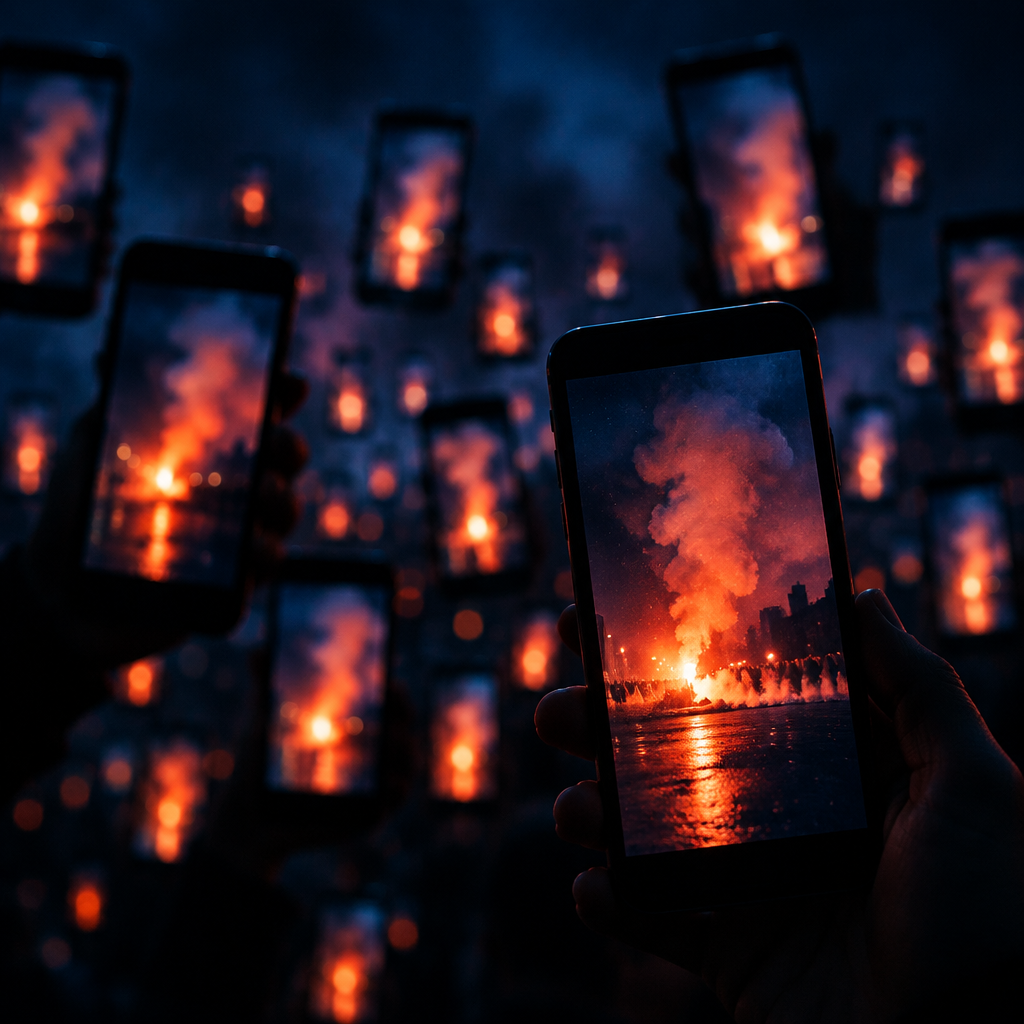
A Russian Network Posed as Western Media During France's Riots. MAGA Accounts Got 17 Times the Reach
An internal EU assessment says the Operation Overload network circulated videos impersonating Western outlets, claiming migrants had raped protesters and that attacks were imminent. A separate French assessment found the top ten pro-Russian posts drew 2.8 million views while the top ten MAGA-linked posts drew more than 49 million.
A covert Russian network used social media to exploit last month's riots in France, circulating fabricated reports about migrants and portraying the government as unable to maintain order, according to an internal EU assessment seen by Reuters and reviewed alongside a separate assessment compiled by the French foreign ministry.
The EU document identifies the network as Operation Overload, a Russian-aligned information operation active since September 2023 that has targeted Western public figures, institutions and media outlets in order to discredit them and weaken support for Ukraine. In this instance it circulated videos impersonating Western media organisations, aimed at French audiences.
Some posts falsely claimed that migrants had raped protesters. Others warned that terrorist attacks were imminent. The material also sought to present French leaders as simultaneously weak and increasingly authoritarian, a combination that works better in an algorithm than it does in an argument.
The finding that matters most
The EU assessment examined activity between 7 and 21 October, the period in which demonstrations over the cost of living and declining public services escalated into some of the worst violence France has seen in decades.
Its central conclusion is a restraint, not an accusation: there is no evidence that Russia or any other foreign actor instigated or escalated the protests. The activity is described as the "opportunistic exploitation of unrest".
That distinction is the difference between a claim that can be defended in public and one that cannot. It is also the reason the assessment's general warning reads as it does: "Such events offer opportunities to undermine national governments, fuel fear and division, and shape public perceptions ahead of elections."
The audience was not where the content came from
The French foreign ministry's assessment adds a finding that reframes the story. It compared the reach of different sets of accounts posting about the unrest between 16 and 18 October.
The ten most-viewed posts by pro-Russian accounts received 2.8 million views. The ten most-viewed posts from MAGA-linked officials, media outlets and influencers accumulated more than 49 million views over the same period. The equivalent posts from Israeli officials, government accounts, media outlets and influencers received more than 35 million views.
The French assessment says those accounts promoted what it describes as "hostile narratives" about the unrest, linking it to radical Islamism and migration. On those numbers, the fabricated Russian content reached a fraction of the audience that domestic political voices in two allied countries reached with the same framing.
Reuters said it could not independently verify the claims in either assessment. Benjamin Netanyahu's office and the Israeli foreign ministry did not respond to requests for comment. French officials pointed to President Emmanuel Macron's statement on 21 October, in which he said there had been no visible foreign interference behind the protests but that foreign actors had manipulated information about them.
How the operation works
The Institute for Strategic Dialogue described Operation Overload in a report last year as a persistent, high-volume Russian influence campaign. Its methods, according to that research: impersonating trusted sources, producing fake news-style videos, using artificial intelligence to clone the voices of experts, and forging newspaper headlines.
Those techniques are chosen for a specific reason. They do not require an audience to believe a Russian account. They require an audience to believe a screenshot, or a video that looks like it came from a broadcaster they already trust, or an audio clip of someone whose voice they recognise. Verification is the step the format is designed to skip.
Elina Treyger, a senior political scientist at the RAND Corporation, told Reuters that such campaigns form part of a long-term "narrative competition" that can gradually shape perceptions of Western democracies. She said they also fuel anti-immigrant sentiment, potentially pushing European voters toward political extremes.
The strategic logic, stated plainly
Operation Overload's wider purpose, as the EU assessment describes it, is to weaken European support for Ukraine by arguing that governments prioritise assistance to Kyiv over problems at home. That is the same message that appears in European election campaigns without any Russian involvement, which is what makes it effective and what makes attribution difficult.
The operation does not need to invent the grievance. It needs to arrive early, look local, and let the amplification happen elsewhere.
What this means for the next French election
France votes in 2027, and the EU assessment explicitly frames unrest as an opportunity to shape perceptions "ahead of elections". The mechanism it describes does not depend on the specific crisis. Any period of domestic disorder, in any member state, offers the same opening: a window of days in which verification is slow, emotions are high, and impersonating a familiar outlet is cheap.
The uncomfortable number in the French assessment is not the 2.8 million. It is the 49 million. On that evidence, the constraint on the spread of a hostile narrative about immigration and disorder in Europe is not the capacity of a foreign network to produce it, but the willingness of domestic political actors to amplify it.
Sources
- ↗Reuters, 9 November 2026: Covert Russian network exploited French riots on social media, EU report says
- ↗Kyiv Post, 9 November 2026: Russian Network Used French Riots to Spread Anti-Migrant Lies
- ↗United24 Media, 9 November 2026: Russia Tries to Turn France's Violent Protests Into a Disinformation Weapon, EU Investigation Finds
- ↗EU Today, 9 November 2026: Russian Disinformation Network Exploited French Protests to Undermine Macron, EU Report Finds
Study Tips & Discussion
(0)Log in to join the discussion.
No comments yet — be the first to share your thoughts!
More in Geopolitics & Security
Related Articles
Days After the Blue Wave, G7 Allies Get Their First Look at Trump's America
7 min read
Europe Gets a Congress It Did Not Vote For and Cannot Count On
5 min read
Brussels Puts a Price on Peace: E3, Kyiv and Washington Draft Ukraine's Post-War Economy
6 min read