Ukraine Restarts Refinery Strikes Days After Trump-Pressed Pause, Hitting Rosneft's Novokuibyshevsk Plant
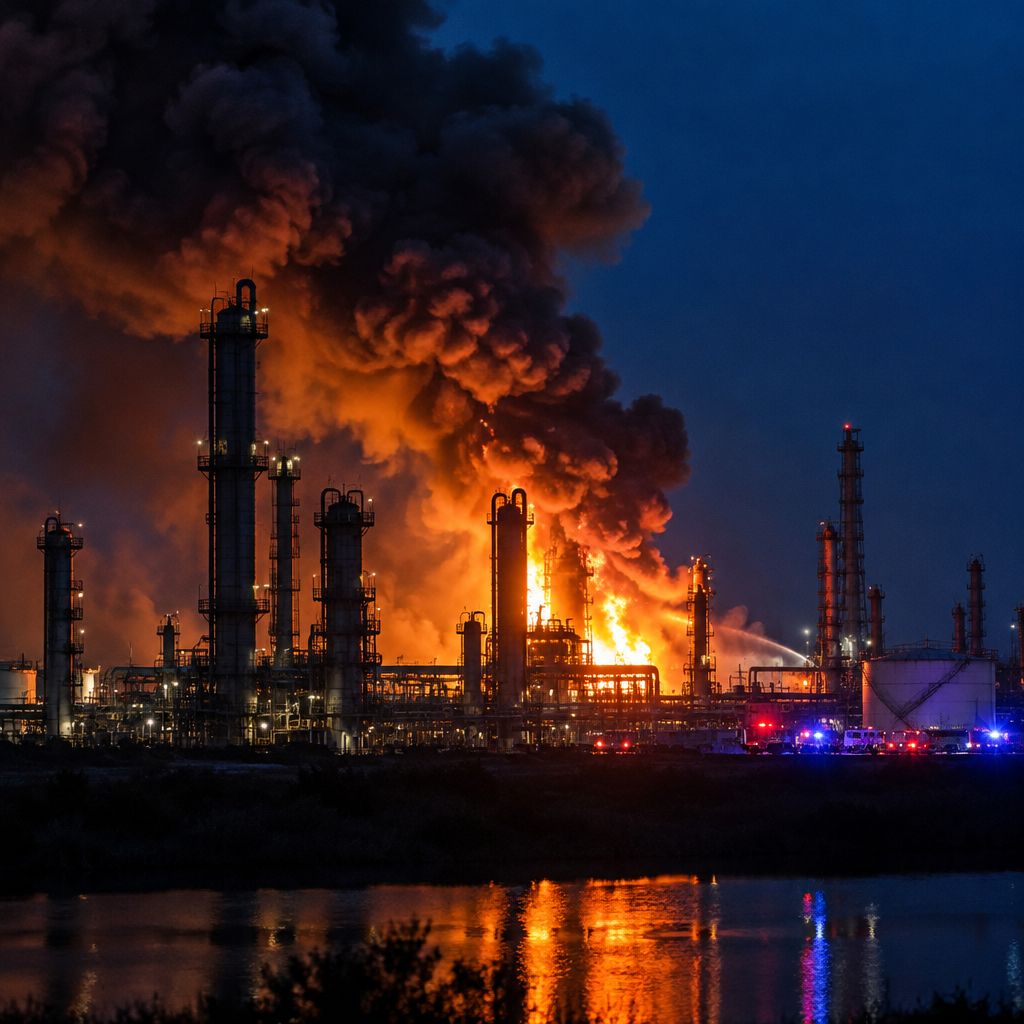
Long-range FP-1 drones struck Rosneft's Novokuibyshevsk refinery in Russia's Samara region early on 30 October, setting the plant alight and ending a roughly two-week pause that Ukrainian forces had observed under pressure from Washington. At least three people were killed in the region, according to Russian reports. The strike reopens the sharpest divergence between Kyiv's military logic and the Trump administration's oil-market calculus.
Ukrainian long-range drones struck the Novokuibyshevsk oil refinery in Russia's Samara region in the early hours of Friday, igniting fires at the facility and ending a pause in attacks on Russian refining capacity that had lasted roughly two weeks.
The Samara regional governor blamed Ukraine for the attack. Russian Telegram channels and the Moscow Times reported that at least three people were killed, with two deaths in the southern Samara region among emergency responders working on fires at industrial sites.
The refinery is operated by Rosneft and, according to company disclosures, can process around 8.8 million tonnes of crude oil a year. It is configured to produce jet fuel, among other products, which makes it a militarily relevant target rather than a purely economic one.
Fire Point confirms the weapon
Ukrainian defence company Fire Point confirmed that its FP-1 long-range drones were used in the strike. The FP-1 is a domestically produced airframe designed for deep strikes at ranges that put the Volga region within reach of launch positions inside Ukraine, and its repeated employment against Russian refining has made Fire Point one of the more consequential private defence firms in the war.
Ukrainian officials have characterised the campaign against refineries as legitimate military targeting, on the grounds that refined products feed Russian aviation and ground logistics. Independent analysts have generally supported that assessment while noting the secondary effect on global product markets.
The pause Washington wanted
The strike broke a lull that the Wall Street Journal reported had been imposed under pressure from US President Donald Trump. The suspension followed Russian attacks that killed 27 civilians on Thursday of the previous week, a toll that Ukrainian officials cited as evidence that restraint bought no corresponding reduction in Russian violence.
President Volodymyr Zelensky's office has not described the pause as an externally imposed ban, framing it instead as an operational decision. Ukrainian officials have consistently maintained that they retain discretion over target selection. The resumption of strikes is consistent with that framing and inconsistent with the suggestion of an American veto.
The underlying tension is straightforward. Washington is focused on global oil and diesel prices, and Russian refinery outages tighten product markets at a moment when European gas has already broken €100 per megawatt hour. Kyiv is focused on degrading a revenue stream and an industrial input that sustain the Russian military. Both calculations are rational, and they point in opposite directions.
Why refining is the vulnerable node
Russia's refining system is unusually exposed to drone attack relative to its upstream oil production. Refineries are large, fixed, thermally sensitive installations with distillation columns and processing units that cannot be hardened quickly, and a single damaged unit can force prolonged partial shutdowns. Repeated strikes have already taken a meaningful share of Russian refining capacity offline for extended periods across the past two years.
Repair capacity is the binding constraint. Western sanctions have restricted access to specialised components, catalyst supplies and engineering services, which means each successful strike imposes a longer outage than the physical damage alone would suggest. That asymmetry is precisely why the campaign has been effective: the cost to Ukraine is a drone, and the cost to Russia is imported equipment it cannot easily obtain.
What happens next
The immediate question is whether Washington responds with consequences for intelligence sharing or targeting support, or treats the strike as tolerable. The second is whether Ukraine now resumes a sustained campaign or conducts intermittent attacks calibrated to political signals.
European capitals will be watching both. The Commission proposed €45 billion in further support for Ukraine on the same day as the strike, and the political case for that package is strengthened, not weakened, by evidence that Kyiv is willing to impose costs on Moscow without waiting for permission.
Study Tips & Discussion
(0)Log in to join the discussion.
No comments yet — be the first to share your thoughts!
More in Geopolitics & Security
Related Articles

A Russian Network Posed as Western Media During France's Riots. MAGA Accounts Got 17 Times the Reach
7 min read
Days After the Blue Wave, G7 Allies Get Their First Look at Trump's America
7 min read
Europe Gets a Congress It Did Not Vote For and Cannot Count On
5 min read