Brussels Puts a Price on Peace: E3, Kyiv and Washington Draft Ukraine's Post-War Economy
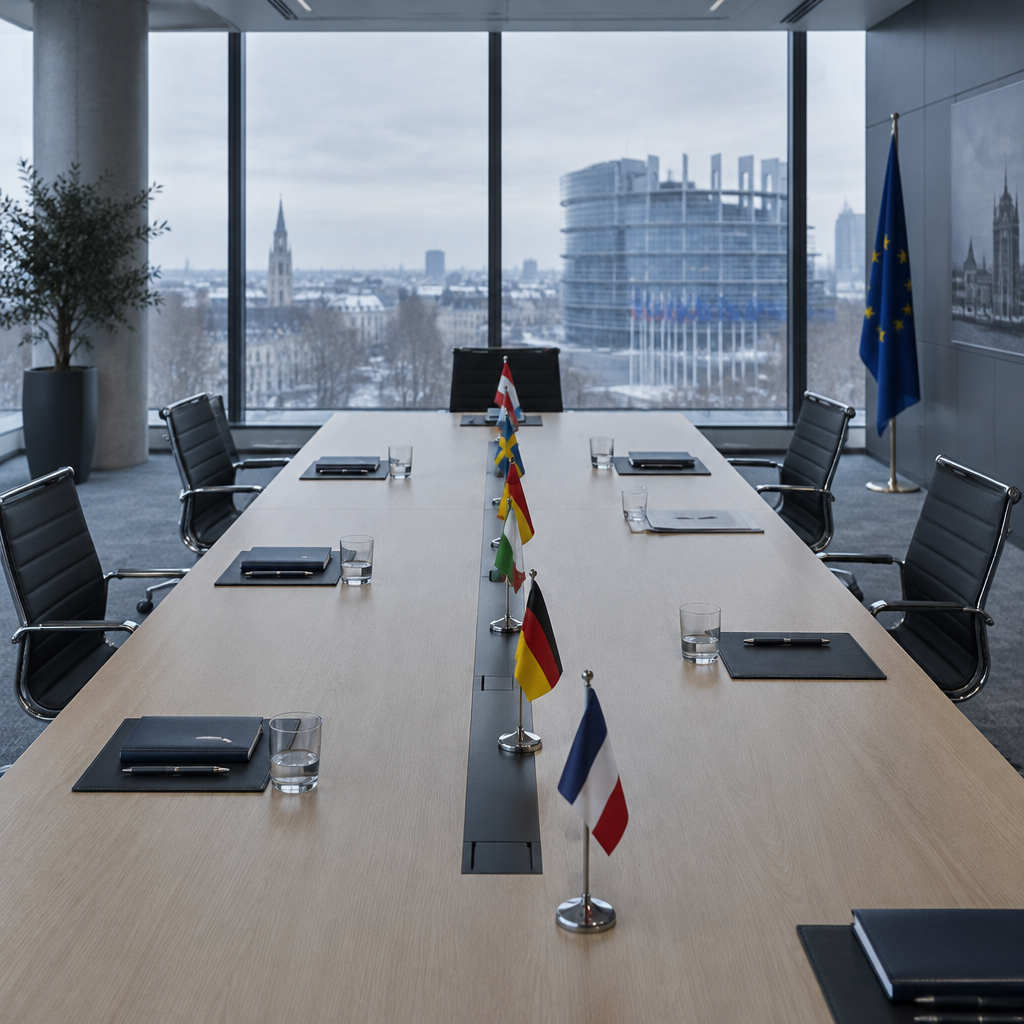
The Commission convened Germany, France, the UK, Ukraine, the US, NATO and the World Bank on 4 November to work through scenarios for Ukraine's post-war economy. It is the first time the reconstruction track has been merged with the peace talks, days before Abu Dhabi.
The European Commission hosted delegations from Germany, France and the United Kingdom, together with Ukraine, the United States, NATO and the World Bank, in Brussels on 4 November to discuss Ukraine's post-war reconstruction and economic prospects. The meeting followed talks held in Miami and precedes the trilateral round scheduled for 10 and 11 November in Abu Dhabi.
According to the Commission, the discussion focused on outlining scenarios for Ukraine's post-war economic development and on identifying the instruments to support growth. The Commission emphasised the reform programme Kyiv is implementing as part of the accession process, describing it as a factor in stability, investor confidence and the attraction of private capital and international support.
The EU has provided €231.5 billion to Ukraine since the start of Russia's full-scale invasion.
This is a different meeting from the usual donor round
Reconstruction conferences are familiar. They produce pledges, a list of priority sectors and a photograph. What is unusual here is the composition and the timing.
The E3 format, meaning France, Germany and the United Kingdom, is the grouping that has taken over European coordination on Ukraine as the American role has fluctuated. NATO's presence puts security guarantees in the same room as investment planning, which matters because no insurer, lender or equity investor will underwrite reconstruction in a country without an agreed security arrangement. The World Bank brings the damage assessment methodology and the ability to structure guarantees. Ukraine is present as the counterpart, not the recipient.
Holding it four days before Abu Dhabi is deliberate. The delegations are not discussing how to rebuild a country after a settlement has been reached. They are establishing what the settlement has to contain for the economics to work, which then becomes a European input into the American-mediated process.
The numbers being discussed behind the language
The Commission's public formulation is careful: refining the scenarios for Ukraine's post-war economic development and prosperity, work that builds on a framework drawn up in recent months with Kyiv and Washington.
The pressure underneath is straightforward. Ukraine faces a budget shortfall of roughly €70 billion next year, according to reporting from Brussels, and its 2027 financing is not secured. The European Union has its Ukraine Support Loan and the proceeds of immobilised Russian assets under discussion, but the arithmetic of reconstruction, defence and running the state already exceeds what has been committed.
The Commission's insistence on the accession reform programme is not incidental to the economics. Rule of law conditionality, anti-corruption architecture and judicial independence are the things that determine whether private capital treats Ukraine as an emerging market or as an uninvestable risk. Framing reforms as the precondition for attracting investment puts the accession process in the service of the recovery case, and gives Brussels leverage over sequencing.
The security problem the money cannot solve
None of this works while the war continues at its current intensity. In the same 24 hours, Russian strikes triggered the worst water outage in Kyiv since the full-scale invasion began, and the death toll from a strike on a village in Zaporizhzhia oblast rose to 40.
European officials involved in the diplomacy, including the Norwegian prime minister and the Finnish president, have been working the channel to Moscow directly, with a 90-minute call with Vladimir Putin described as constructive by those briefed on it. The logic behind that parallel track is that if Europe waits until all 27 member states agree on a single representative for negotiations, the process would take years.
That is the honest description of Europe's structural weakness in this file: it can convene the money, the institutions and the technical expertise, but it cannot speak with one voice fast enough to shape a negotiation being run by Washington.
What to watch
The Abu Dhabi round on 10 and 11 November is at team level, with delegates from Ukraine, Russia and the United States holding technical negotiations that could lead to a leader-level summit. Kyiv has consistently called for a ceasefire along the current line of contact, while Moscow has demanded Ukraine cede territory it does not occupy.
The Brussels meeting matters because it establishes that Europe's contribution to any settlement will be an economic one, and that it intends to define the terms of that contribution before the security questions are settled rather than after.
Sources
- ↗Eunews, 4 November 2026: The EU Commission brings together international partners to prepare for Ukraine's reconstruction
- ↗Euronews, 4 November 2026: Brussels to host talks on Ukraine's reconstruction with key allies
- ↗Kyiv Independent, 4 November 2026: Ukraine war latest, Kyiv suffers worst water outage of full-scale war
Study Tips & Discussion
(0)Log in to join the discussion.
No comments yet — be the first to share your thoughts!
More in Geopolitics & Security
Related Articles

A Russian Network Posed as Western Media During France's Riots. MAGA Accounts Got 17 Times the Reach
7 min read
Days After the Blue Wave, G7 Allies Get Their First Look at Trump's America
7 min read

Europe Gets a Congress It Did Not Vote For and Cannot Count On
5 min read