EU and Canada Seal 'Alliance for the Future' in Montreal, but 'Associate Member' Label Is Stripped Out
The 21st EU-Canada summit closed in Montreal with a new 'alliance for the future', a signed digital trade deal, an EIB mandate for Canadian critical minerals and a €500 million Canadian contribution to the EU's €90 billion loan for Ukraine. But Germany and a handful of member states forced the removal of the 'associate member' label from the joint statement, exposing how unsettled the bloc's own vocabulary for strategic partnership remains.
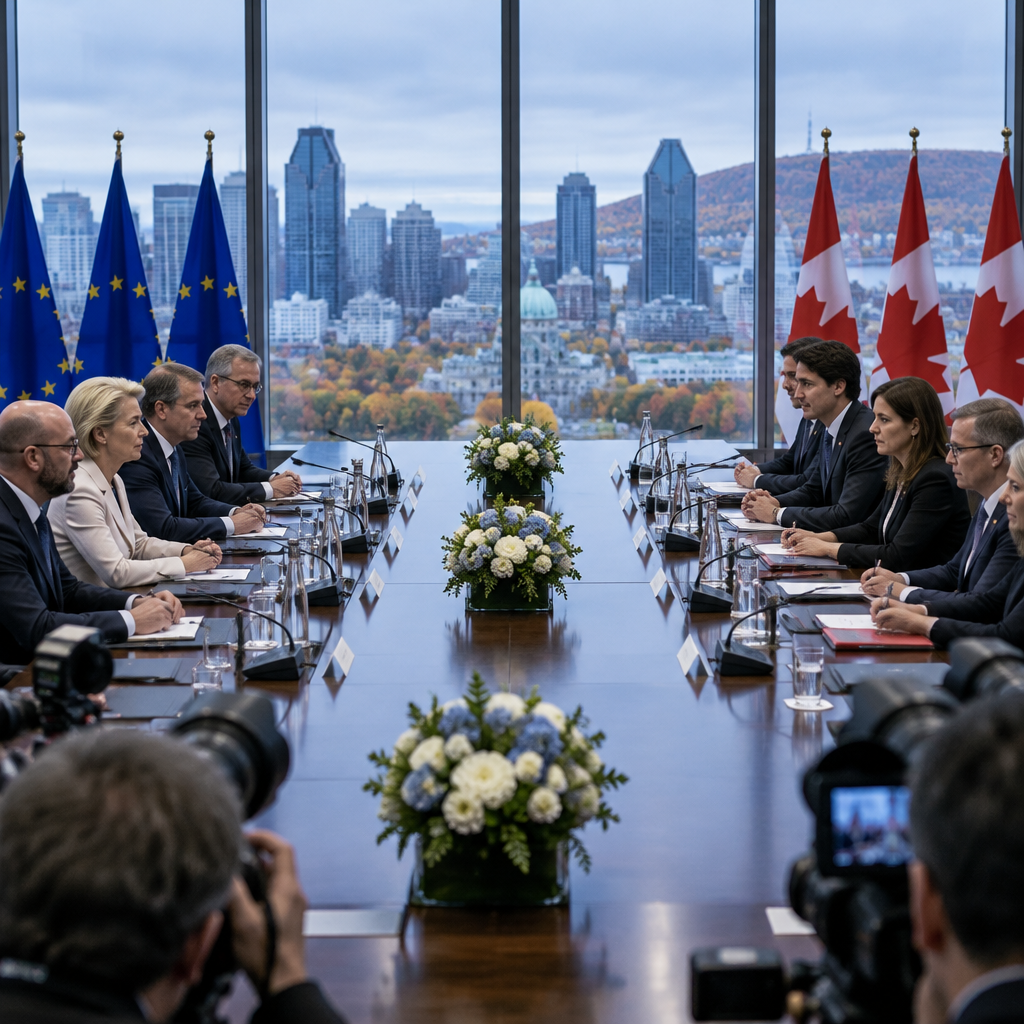
The European Union and Canada closed their 21st bilateral summit in Montreal on Friday by announcing an "alliance for the future", a deliberately open-ended framework that both sides presented as a response to a more dangerous and less predictable world order.
Canadian Prime Minister Mark Carney, European Commission President Ursula von der Leyen and European Council President António Costa spent two days in the Canadian financial capital assembling a package that reaches well beyond the comprehensive economic and trade agreement the two sides have operated since 2017.
"The world's becoming more dangerous and divided. Our societies are being shaken by new storms," Carney told a closing press conference, citing eroding democratic norms and "the weaponisation of trade". "Together, Canada and the European Union are anchoring the ground."
Von der Leyen framed the arrangement in defensive rather than confrontational terms. The alliance, she said, was "not against anyone else, but for our common strength".
What was actually signed
Three deliverables carry practical weight. Brussels and Ottawa signed a digital trade agreement, a separate arrangement allowing the European Investment Bank to finance Canadian critical minerals projects, and a Canadian commitment to join the EU's €90 billion support loan for Ukraine with an initial €500 million contribution.
The minerals agreement addresses a structural European vulnerability. The EU sources the overwhelming majority of its rare earths and critical raw materials from China, and Canada holds substantial deposits but lacks the processing infrastructure and capital to bring mines into production. An EIB mandate converts a political statement into a bankable instrument, though it does not by itself resolve permitting timelines that in Canada routinely run to a decade.
The two sides also agreed to deepen cooperation on satellite connectivity and navigation, and began technical work on Canadian participation in Erasmus and in Galileo, the EU's alternative to the American GPS system. Brussels opened its high-performance computing facilities to Canadian researchers, startups and industry.
The fight over a phrase
The summit's most revealing episode concerned nomenclature rather than substance. Von der Leyen said publicly that Canada would become the EU's first "associate member". Germany and a small group of member states objected, arguing that the status does not exist in the EU treaties and would need legal definition before being used. The term was removed from the joint statement.
Carney nonetheless adopted the phrase himself, telling journalists he expected negotiations to conclude in June and that its "substance" would be settled over the coming months. Reuters reported that the two sides had committed to defining the "deepest possible partnership, short of accession" by the mid-2027 summit.
The episode matters beyond protocol. It demonstrates that the EU's executive can propose a new category of partnership but cannot deliver one without unanimous member state consent, and that a single large member state can delete a concept from a communiqué even when both principals are using it in public.
Architecture, not a one-off
Both leaders described the Canada arrangement as the first element of something larger. Von der Leyen said the two would form the "nucleus" of an "alliance for the future" open to other like-minded partners. Carney said it would focus on "collective sovereignty and resilience in areas such as AI, energy, critical minerals, quantum, and beyond".
A senior EU official said a core function would be coordinating economic security instruments, including tariffs, so that measures taken by one member of the group do not inadvertently damage another. That is a modest but meaningful step: it implies a consultation mechanism that does not currently exist between Brussels and Ottawa on export controls or subsidy design.
Costa confirmed that Carney would attend a meeting of EU leaders in June, with a separate meeting of European commissioners and Canadian ministers scheduled for the spring.
What to watch
The June leaders' meeting is now the decision point. Three questions will determine whether the alliance becomes an institution or a communiqué: whether member states accept a legally defined associate status, whether the EIB minerals facility is capitalised at a scale that actually moves projects, and whether the tariff coordination mechanism acquires any binding character. On current evidence, the instruments are real and the architecture is not yet.
Study Tips & Discussion
(0)Log in to join the discussion.
No comments yet — be the first to share your thoughts!
More in Geopolitics & Security
Related Articles

A Russian Network Posed as Western Media During France's Riots. MAGA Accounts Got 17 Times the Reach
7 min read
Days After the Blue Wave, G7 Allies Get Their First Look at Trump's America
7 min read
Europe Gets a Congress It Did Not Vote For and Cannot Count On
5 min read