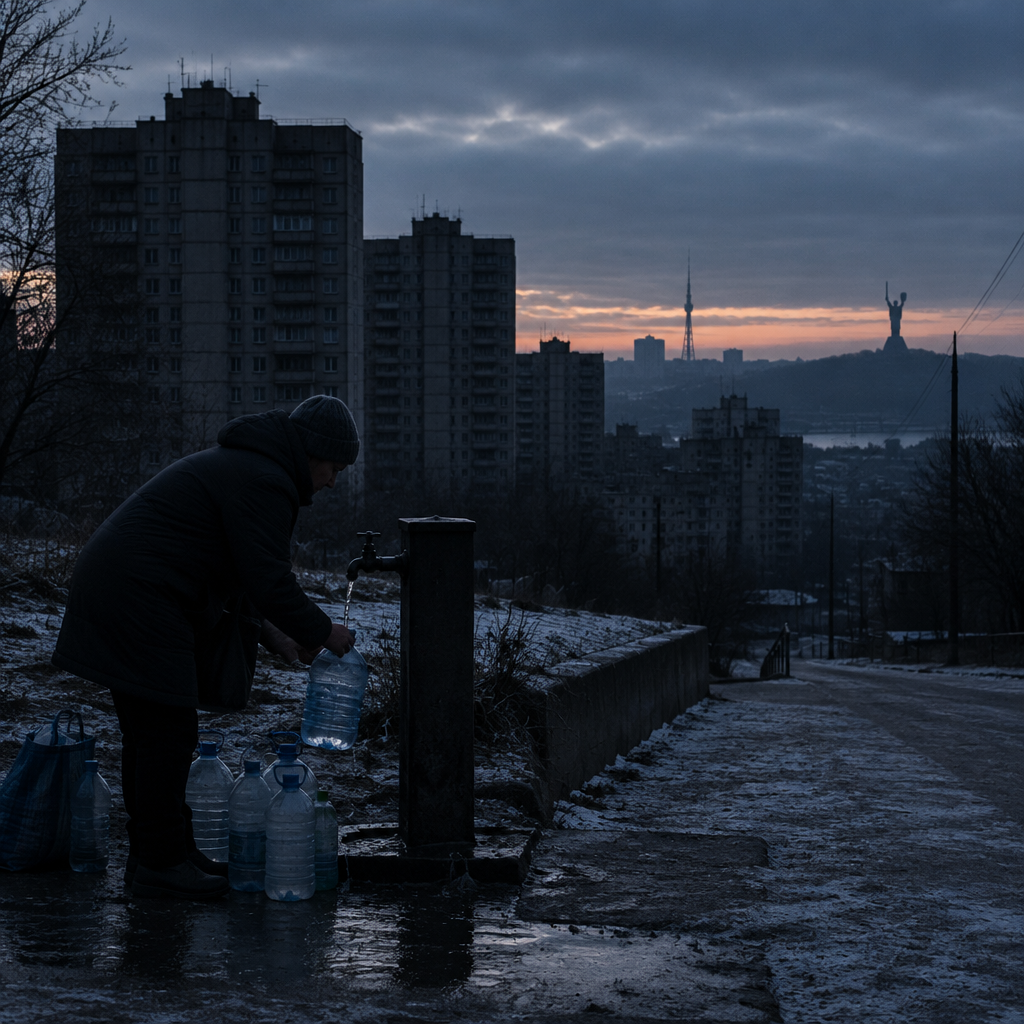
Kyiv Loses Its Water: Russia's Grid Campaign Reaches the Point Where Cities Stop Functioning
Residents of Kyiv went more than 24 hours without running water after the largest Russian strike on Ukraine's energy system this year. The country's water institute says it expects the situation to deteriorate further in winter.
Residents across Kyiv were left without water for more than 24 hours after Russian strikes on 3 November cut power to the capital, in the most severe water outage the city has experienced since the full-scale invasion began. The strikes were the largest on Ukraine's energy infrastructure this year.
Kyivvodakanal, the city's water utility, said the attack effectively cut off all supply on 3 November, with outages reported in most districts including the centre, where some restaurants closed their bathrooms to customers. By the afternoon of 4 November workers had stabilised the system, though it took several more hours to fill the networks, restore pressure and get water flowing to consumers.
Why this time was different
The mechanism is simple. Kyiv's water supply is large and centralised, and pumping water through it requires electricity. When the grid fails, the taps fail.
What changed is redundancy. Kyiv has suffered water outages after earlier attacks, but they lasted hours rather than a full day or more. Russian strikes in January crippled power generation at three of the city's combined heat and power plants. "We used to always have the option to power water supply from one of the CHPs, but as of now, we have lost this opportunity," Oleksandr Kharchenko, director of the Energy Industry Research Center, told the Kyiv Independent.
Mykhailo Yatsuk, director of the Institute of Water Problems and Land Reclamation, was blunt about the trajectory: "This is the most serious water outage in Kyiv since the war began. It is also expected that the situation will worsen in the winter."
A manager at a water pump company, speaking on condition of anonymity, said residents should now stockpile water. "Previously, we didn't think that we needed water reserves. But now we do. The situation is getting worse after every attack."
That is the practical consequence of a systematic campaign. Each strike removes capacity that is not replaced at the same rate, and each repair cycle consumes stock, crews and money that cannot be spent twice.
Komyshuvakha: 40 dead and the search still running
On 2 November, Russian forces struck the village of Komyshuvakha in Zaporizhzhia oblast with aerial bombs, hitting a school building used as a humanitarian aid distribution centre. The death toll reached 40 on 4 November as search operations entered a third day, and President Volodymyr Zelenskyy said more than 30 people may still be trapped under the rubble, with some bodies not yet identified.
Russia used a FAB-3000 aerial bomb, which carries more than 1,000 kilograms of explosives and has a blast radius of up to 250 metres. Zelenskyy said the first strike hit the school where residents had gathered for aid, and that after it Russia dropped another nine bombs on a shelter where people had taken refuge.
"Russian forces could not have been unaware that local residents who remained in Komyshuvakha received humanitarian aid there every week," he said, calling it an exceptionally horrific strike and evidence that Russia does not want to de-escalate. He also noted how little international reaction the attack had drawn.
The industrial arithmetic on the other side
Ukraine's military intelligence service, HUR, said on 4 November that Russia can produce more than 200 ballistic and cruise missiles a month, of which up to 110 are ballistic, and that it holds stockpiles of up to 700 ballistic missiles and several thousand cruise missiles of various types.
Those figures explain why sanctions have not closed the gap and why Ukraine's requests have narrowed to a single item. In a call with US envoys Steve Witkoff and Jared Kushner on 4 November, ahead of the Abu Dhabi talks, Zelenskyy said air defence was a crucial priority: "We need interceptors for Patriot systems to protect lives from Russian attacks."
Air defence is now the binding constraint on Ukraine's ability to keep its cities functioning through winter. Interceptor production in Europe and the United States is booked out for years, and the systems Ukraine needs most have the longest lead times. No amount of additional financing converts into interceptors faster than the lines can produce them.
Until that changes, the pattern is set: strikes on generation, water systems that cannot run without power, and a winter in which the question is not whether the grid holds but how long each outage lasts.
Sources
- ↗Kyiv Independent, 4 November 2026: Kyiv suffers worst water outage of full-scale war after mass Russian assault
- ↗AP, 4 November 2026: Russian attacks disrupt power in Kyiv, while the death toll in a stricken village rises to 40
- ↗Kyiv Independent, 4 November 2026: Death toll from Russian attack on Komyshuvakha rises to 40
Study Tips & Discussion
(0)Log in to join the discussion.
No comments yet — be the first to share your thoughts!
More in Defense & Security
Related Articles
Von der Leyen Goes to the Black Sea, Where the War Has Already Arrived
7 min read
2,800 Troops, 11 Nations, No Americans: Europe Rehearses the Army It Would Send to Ukraine
7 min read
Someone Is Setting Europe's Freezers to 50C. Now the Commission Is Investigating
6 min read