2,800 Troops, 11 Nations, No Americans: Europe Rehearses the Army It Would Send to Ukraine
Britain and France will lead KOALICJA 26.2 from 9 to 22 November, bringing 2,800 troops from 11 countries to Poland, France and Turkey to test how to move, protect and supply the Multinational Force-Ukraine. US troops will not take part. The drills begin the day before US, Russian and Ukrainian negotiators meet in Abu Dhabi.
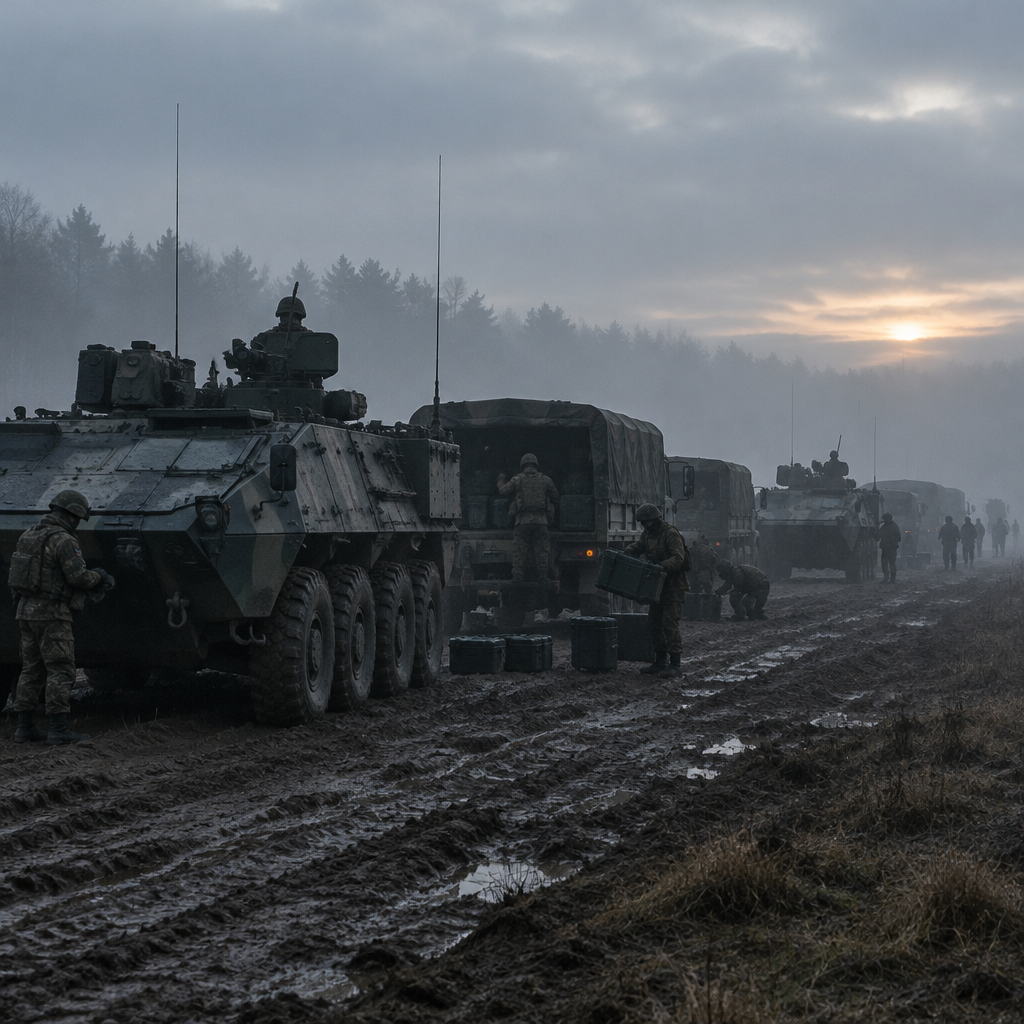
Around 2,800 troops from 11 countries will gather in Poland next week for the first major military exercise of the Coalition of the Willing, a rehearsal for deploying a multinational force into Ukraine once the war with Russia ends.
The drills, named KOALICJA 26.2, will be jointly led by Britain and France from 9 to 22 November and staged across Poland, France and Turkey under the coalition's military arm, the Multinational Force-Ukraine. American troops will not participate. The exercise begins the day before US, Russian and Ukrainian negotiators meet in Abu Dhabi on 10 and 11 November.
Belgium, Estonia, France, Germany, Lithuania, the Netherlands, Spain, Sweden, Turkey and Britain are taking part, with Poland as host. Nearly 2,000 Polish soldiers will join the foreign contingents.
What they are actually practising
According to the British Ministry of Defence, the drills will combine air, land and sea forces to test how to move, protect and supply a force that would help rebuild Ukraine's armed forces once the fighting ends. They will also test command-and-control arrangements and how the different national components integrate as a single formation.
The stated eventual missions are concrete: securing critical infrastructure, training Ukraine's military, helping protect Ukrainian airspace, and clearing mines from the Black Sea so commercial shipping can return to Ukrainian ports.
Britain is sending 300 personnel, including soldiers from the 7th Light Mechanised Brigade, the Desert Rats, to rehearse logistical movement. France is sending hundreds, including a unit equipped with around 50 contact drones, the second such deployment after one sent to Romania. Turkey will not send troops to Poland but will stand up the force's maritime element in Istanbul to test mine-clearance arrangements.
"This isn't a hypothetical plan; it's a real force, ready to help Ukraine once the fighting stops," British Defence Secretary Wes Streeting said.
What the force is not
The Multinational Force-Ukraine will not have a peacekeeping or ceasefire-monitoring mandate. It will not operate under NATO command. It would move into Ukraine only after a ceasefire and only at Kyiv's request.
That distinction matters legally and politically. A peacekeeping force implies impartiality between two parties and rules of engagement built around observing a line. This force is designed to strengthen one side's army after a settlement, which makes it a security guarantee rather than a buffer.
"Ceasefire monitoring would be a different task from that of the multinational force, whose aim is different in nature because it is meant to support the Ukrainian army in its ability to be beefed up," said Gaël Veyssière, a former French ambassador to Ukraine.
The numbers problem
Britain and France have each said they are prepared to contribute roughly 5,000 troops. That is a fraction of what militaries think a credible tripwire requires: the Center for Strategic and International Studies assessed last year that even a minimal presence would need 10,000 to 25,000 troops. Because only about a third of any force is frontline-ready at a time, rotation requirements push the total far higher.
The exercise does not specify the final size of a deployable force, which is a way of avoiding the question. A 2,800-troop rehearsal across three countries is a command-and-control test, not a deployment plan.
Poland's role is carefully limited. Warsaw will manage the movement of the force into Ukraine after a war but will not send its own soldiers across the border. That is a domestic political constraint as much as a strategic choice, and it means the logistical spine of any deployment will run through a country that has excluded itself from the sharp end.
Putin has already answered
Russian President Vladimir Putin has rejected any foreign troop presence in Ukraine and warned in September 2025 that Western forces deployed there would be legitimate targets. That warning is the central risk in the entire concept: a force designed to deter a renewed attack is only a deterrent if Moscow believes attacking it would be costly.
The timing of the exercise is not accidental. It runs through 22 November, after the Abu Dhabi round concludes and days before EU leaders meet in Dublin on 13 November to argue about who, if anyone, speaks for Europe in these talks. Ukraine's President Volodymyr Zelenskyy has pressed allies to move quickly, noting that Russian strikes on the power grid continue as the country enters its fifth winter of full-scale war.
"Peace has no alternative, and postwar security guarantees must be truly cast-iron," Zelenskyy said this week. A drill in the Polish mud is one way of arguing that they are.
Study Tips & Discussion
(0)Log in to join the discussion.
No comments yet — be the first to share your thoughts!
More in Defense & Security
Related Articles
Von der Leyen Goes to the Black Sea, Where the War Has Already Arrived
7 min read
Kyiv Loses Its Water: Russia's Grid Campaign Reaches the Point Where Cities Stop Functioning
5 min read

Someone Is Setting Europe's Freezers to 50C. Now the Commission Is Investigating
6 min read