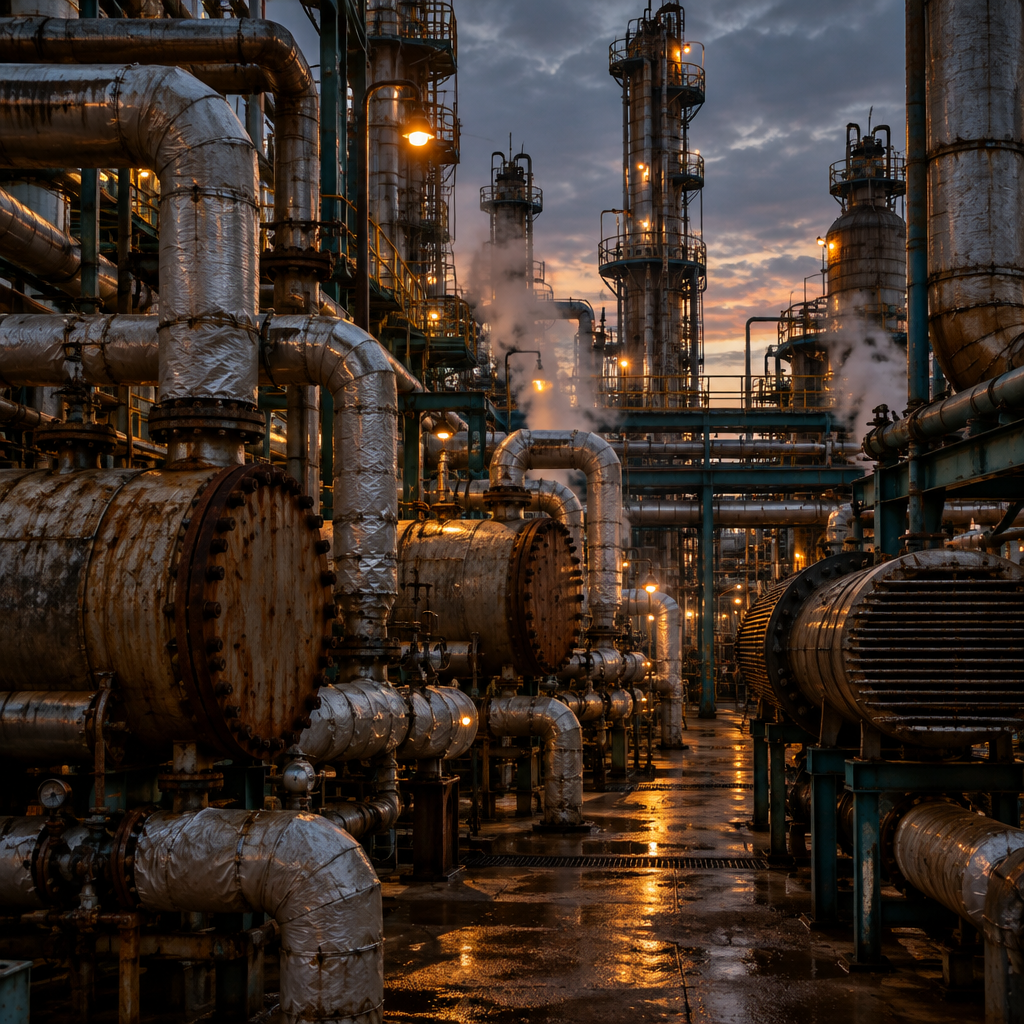
Brussels Hands Industry 121 Million Free Carbon Permits and Calls It Competitiveness
Council and Parliament negotiators agreed on Thursday to raise free allocation under the emissions trading system's heat and fuel benchmarks to about 121 million allowances between 2026 and 2030, 33 million more than the Commission proposed in July. Chemicals, pulp and paper and food processing are the intended beneficiaries. The bill lands on the carbon market.
The Council reached a provisional agreement with the European Parliament on Thursday on a revised law increasing free carbon allowances for industrial sectors covered by the heat and fuel benchmarks of the EU emissions trading system. The deal, announced by the Council, provides a total cushion of roughly 121 million free allowances between 2026 and 2030.
Formal endorsement by both institutions and legal-linguistic revision are still required. The Commission will then adopt implementing rules on how heat and fuel benchmarks are calculated, which is where most of the practical consequences will be decided.
What the benchmarks are for
Free allocation in the EU ETS normally works through product benchmarks: 52 of them, each setting an emissions performance level for a specific output, such as a tonne of steel or a tonne of cement. Installations that beat the benchmark get surplus allowances they can sell; those that lag have to buy.
Heat and fuel, also called fallback benchmarks, are the exception. They allocate allowances on the basis of energy consumption rather than output, for products and processes that no product benchmark covers. They account for around a quarter of total free allocation and are the main protection for chemicals, pulp and paper, and food processing: sectors whose emissions come from process heat at temperatures that electric boilers cannot yet reach economically.
In June 2026 the regular update of those benchmarks cut free allocation for the 2026-2030 period, because the underlying emissions data had improved. Industry and several member states objected that the cut was arithmetic rather than real: it rewarded installations that had already reduced emissions and penalised those facing the same physical constraints as before. EU leaders in June noted the Commission's intention to bring forward a separate proposal.
What the co-legislators did
The Commission's July 2026 proposal made around 88 million allowances available under the existing rules. Negotiators added 28 million allowances that had not previously been allocated because some installations failed ETS conditionalities: the obligations on energy efficiency audits or climate neutrality plans that must be met to receive free allocation.
They then set aside a further 5 million allowances between 2026 and 2030 as targeted support for the most exposed, energy-intensive sectors, shielding them from carbon leakage.
Anything unused under that measure goes to the Modernisation Fund to support investment, and to the Innovation Fund for low-carbon innovation in ETS sectors. That recycling clause is the concession to the Parliament's environment committee, which has argued all year that the money should not simply be handed out without a decarbonisation condition.
The trade-off nobody announced
Every allowance that is given away is an allowance that is not auctioned. Auction revenue is the EU's main source of climate finance: it funds the Innovation Fund, the Modernisation Fund and, from 2026, a share of the Social Climate Fund that is meant to compensate households for the extension of carbon pricing to buildings and road transport.
Adding 33 million allowances over the Commission's proposal, in a market where the price signal is the entire point of the policy, is a transfer from the EU budget and from the carbon price to the balance sheets of chemical and paper plants.
Darragh O'Brien, Ireland's Minister for Climate, Energy and the Environment, framed it in the language the Council now uses for all climate files: predictability for industry, competitiveness at home, production retained within the EU, decarbonisation continuing.
Whether that is what happens depends on the implementing rules. If heat and fuel benchmarks are set on the basis of actual energy consumption without a ratchet, the 121 million becomes a permanent subsidy for existing plant configurations. If they are set with a declining trajectory, it becomes a transition instrument. The Commission writes that regulation alone, and there is no deadline attached to the agreement.
Why this is a competitiveness file now
The revision sits inside the Commission's One Europe, One Market Roadmap, with a completion timeline of the first quarter of 2027. That is the same legislative pipeline producing the Made in Europe rules, the Digital Fairness Act and the delayed tobacco reform.
It is also the reason the ETS file has become a trade file. The carbon border adjustment mechanism charges importers for the emissions embedded in goods, and the free allowances given to European producers are being phased out in parallel so that the two do not overlap. Every extra free allowance for a European chemical plant is, in the CBAM accounting, a subsidy that must eventually be reconciled at the border.
If heat and fuel benchmarks stay generous while CBAM's phase-in continues, the Commission will face the complaint it has been dreading from trading partners: that the European producer is protected twice, once by free permits and once by the border levy.
What to watch
The implementing regulation on benchmark calculation, which the Commission has not yet scheduled. Whether the 5 million ring-fenced allowances actually reach the sectors named, or are absorbed by the largest installations. And whether the Parliament's environment committee treats the recycling to the Innovation Fund as the precedent for the rest of the One Europe, One Market package.
Study Tips & Discussion
(0)Log in to join the discussion.
No comments yet — be the first to share your thoughts!
More in Energy
Related Articles
Five Capitals Tell Brussels to Hurry Up and Let Britain Back Into the Electricity Market
6 min read
Council Gives Fossil Fuel Importers Another Year on Methane, and Argues It Is Doing It for Energy Security
6 min read

The Strait of Hormuz Crisis: Europe's Second Energy Shock in Five Years
4 min read