Europe's Greens Lose the Car: ENVI Votes to Cut the 2035 Target to 87.5%
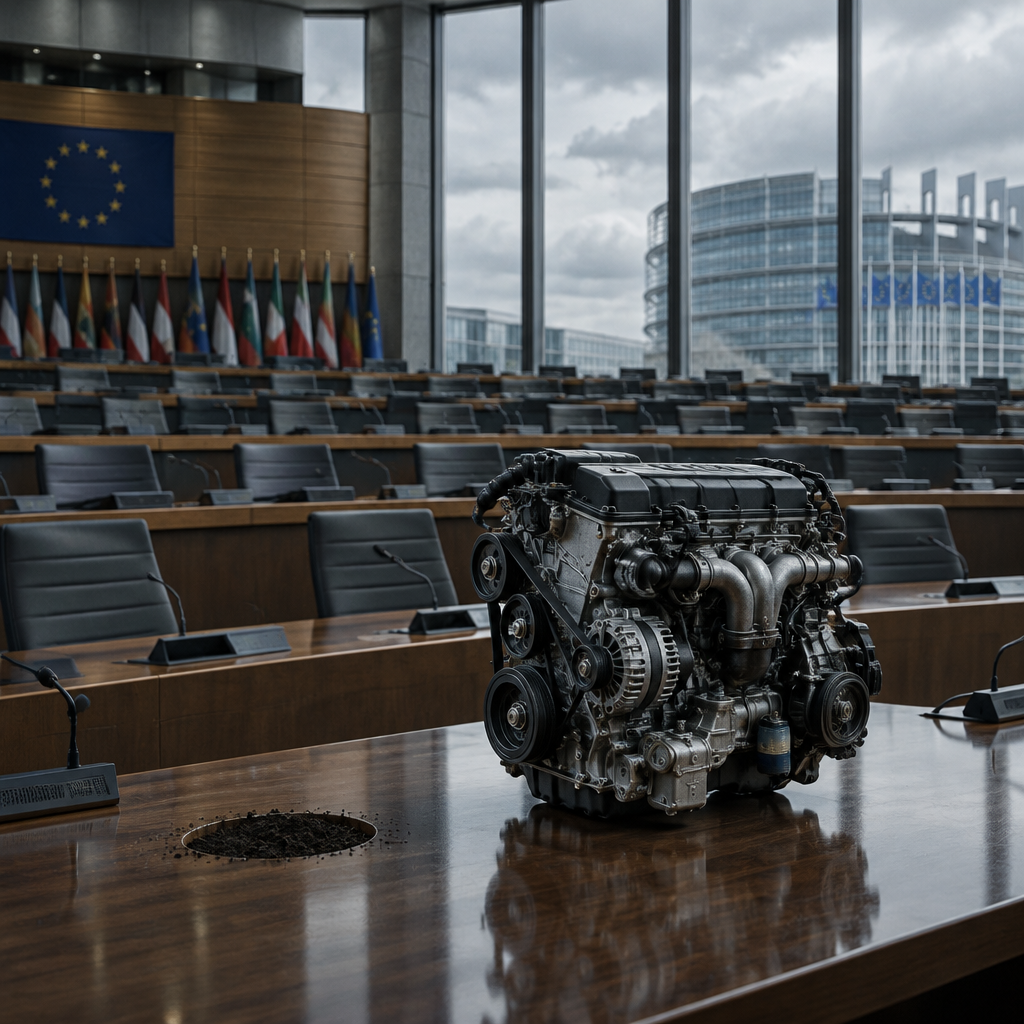
The European Parliament's environment committee voted 48 to 30 to lower the 2035 fleet target from 100% to 87.5%, broaden the definition of a zero-emission vehicle to include renewable fuels, and hand credits to EU-made low-carbon steel. The December plenary now decides whether the combustion engine survives in law.
The European Parliament's Committee on the Environment, Climate and Food Safety voted on 4 November to lower the EU's 2035 CO2 reduction target for new passenger cars from 100% to 87.5%, adopting its negotiating position on the revision the Commission tabled in December. The vote was 48 in favour, 30 against and two abstentions.
The text is a political compromise negotiated in recent weeks between the European People's Party, the Socialists and Democrats and Renew Europe. It now goes to the December plenary, where MEPs must confirm it to give Parliament a mandate for interinstitutional negotiations with the Council.
What the committee actually changed
Four changes matter more than the headline number.
First, the fleet target. Instead of a 100% cut by 2035, manufacturers would face 87.5%, with residual emissions of up to 7.5% against the 2021 benchmark offsettable through credits linked to the use of low-carbon steel produced in the EU. That takes the effective threshold to 95%.
Second, light commercial vehicles. MEPs propose a 35% cut by 2030, down from the 40% in the Commission's text and the 50% currently in force, and 80% rather than 100% by 2035, with the same low-carbon steel credit available up to 7.5%.
Third, the definition of a zero-emission vehicle. It would cover not only vehicles with zero tailpipe emissions but also those running exclusively on eligible fuels, the so-called VEEF category, meaning renewable and low-emission fuels meeting the criteria in the Renewable Energy Directive. Cars burning those fuels would count as zero-emission for the purposes of the regulation, alongside battery electrics.
Fourth, multipliers. Small EU-made electric cars of up to 4.2 metres would count as 1.4 vehicles when calculating average fleet emissions, and energy-efficient EU-made electric models as 1.2. Under a social leasing scheme those multipliers rise by 0.1 to 1.5 and 1.3. Purely electric vans built in the EU count as 1.2 until the end of 2034 and 1.4 from 2035.
The argument the majority accepted
The rapporteur, Massimiliano Salini of Forza Italia and the EPP, framed the outcome as a recovery of technological freedom. "Our agreement marks a turning point for the European automotive industry," he said, adding that it would still be possible to register cars with internal combustion engines without offsetting requirements. On fuels, he argued that decarbonisation "does not mean imposing a single technology", and that vehicles powered exclusively by compliant renewable fuels should be recognised as zero-emission on a par with electric vehicles.
That is a substantive legal claim, not a rhetorical one. Once a plug-in hybrid running on a high share of renewable fuel can be booked as zero-emission, the regulation stops functioning as a manufacturing mandate and becomes a fuel-certification regime.
Industry says not enough, which is instructive
ACEA described the vote as "another step towards a more pragmatic CO2 framework", language that stops well short of satisfaction. Confindustria and Germany's BDI were sharper: they welcomed the compromise but called for an unconditional cut to 90% rather than 87.5% with offsetting, more ambition and flexibility, stronger technology neutrality, a reconsideration of the restrictions on eligible fuels, no mandatory quotas for company fleets, and a tailored approach for small-volume manufacturers.
The industry position is internally revealing. Manufacturers want certainty on volume and cost, and the credit mechanism for EU low-carbon steel imposes a sourcing obligation in exchange for relief. They would rather have a cleaner 90% than a 87.5% tied to European steel purchasing, because the second binds their supply chain to a market where prices and capacity are still uncertain.
Where it goes now
The December plenary is the real test. Two things can happen there. The compromise can hold, in which case Parliament enters negotiations with the Council behind a position the Council's own general approach may already be close to, given the number of member states with automotive supply chains pressing for relief. Or the majority can fray, as it did on other Green Deal files, with S&D under pressure from climate-voting constituents and Renew split between its liberal and its industrial wings.
The Council's position and the timing of trilogues will determine whether the revised regulation is adopted before the review clauses built into the current text force another round. What is no longer in doubt is the direction: the committee of the European Parliament responsible for climate policy has voted to make the 2035 target softer, and to let renewable fuels and European steel buy compliance.
Sources
- ↗Eunews, 4 November 2026: Parliament gives initial approval to the backtracking on the ban on internal combustion engines from 2035
- ↗ACEA, 4 November 2026: ENVI vote marks another step towards a more pragmatic CO2 framework for cars and vans
- ↗Automotive News Europe, 4 November 2026: EU lawmakers vote to further ease CO2 emissions targets
Study Tips & Discussion
(0)Log in to join the discussion.
No comments yet — be the first to share your thoughts!
More in Energy & Climate
Related Articles
Washington Wants Russian Gas Back in Europe. Brussels Says the Law Says No
6 min read

European Gas Breaks €100 for the First Time Since 2022, and Berlin and Rome Start Blaming Each Other
6 min read

EU Signals One-Year Delay to Methane Rules for Energy Imports
4 min read