Spain Votes Tomorrow. The Real Test Is Whether Vox Gets a Seat in the Room.
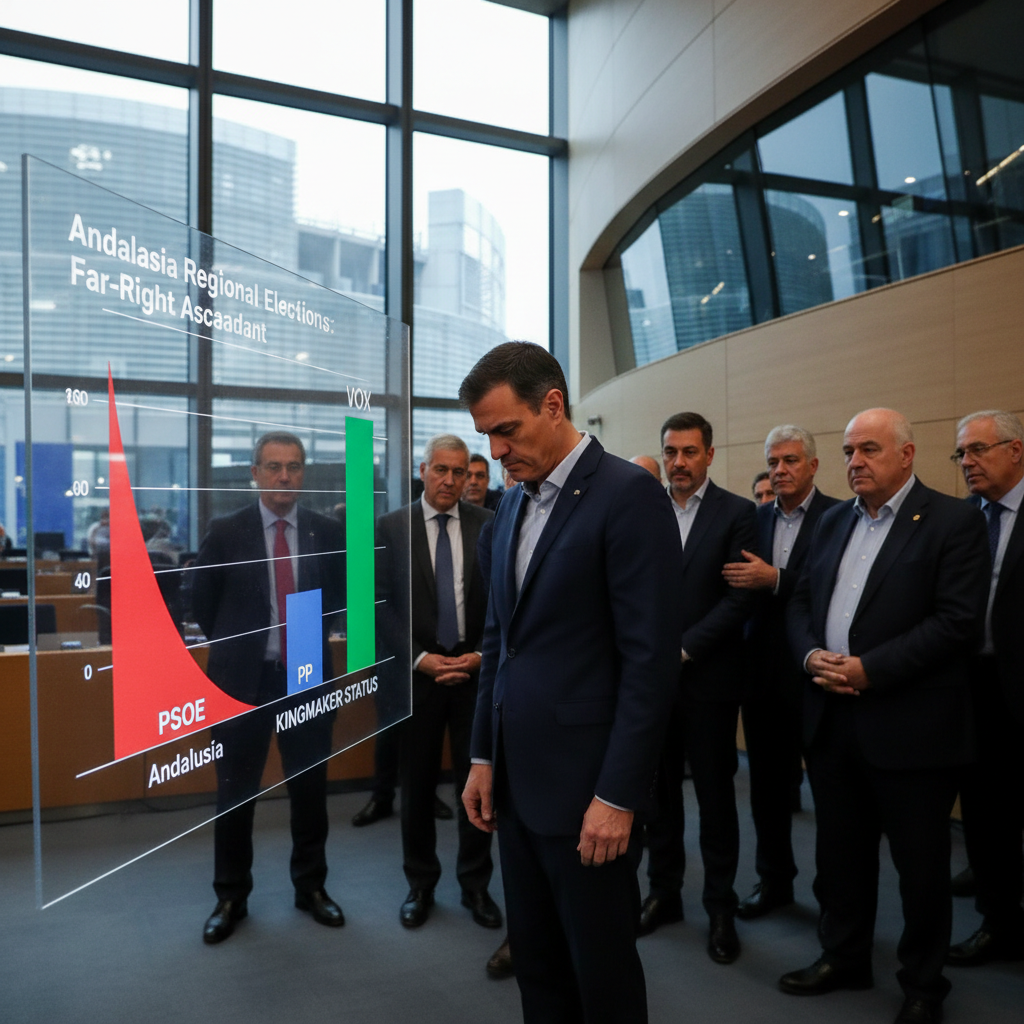
El País's final polling average puts the PP on 31.4 per cent, the Socialists on 29.1 and Vox on 17.9, with several seat projections placing a PP-Vox bloc above the 176 needed for a majority. If Santiago Abascal enters the cabinet, it would be the first far-right party in a Spanish government since 1975, and the first live test of whether Europe's mainstream right has abandoned the cordon sanitaire.
Spain holds its fifth general election in just over a decade on Sunday, and for the first time since the return of democracy the question on the ballot is not only who wins but who governs with whom. The final polling average published by El País on 24 November put Alberto Núñez Feijóo's Partido Popular on 31.4 per cent, Pedro Sánchez's Socialists on 29.1 and Santiago Abascal's Vox on 17.9. Several seat projections based on those numbers place a PP-Vox bloc above the 176 seats required for a majority in the 350-seat Congress of Deputies.
Sánchez made his last appeal to voters on Saturday, asking for a large turnout so the country does not go "backwards". Feijóo closed his campaign on corruption and inflation. Abascal spent the final week on immigration and housing. Nothing in the last stretch of polling suggests the order will change.
Why there is an election at all
Sánchez called the snap vote after Congress rejected two government decrees designed to broaden housing protections, including limits on rent increases and blocks on certain evictions and automatic lease renewals. Congress later ratified a revised version of one of them, limiting rent increases and evictions in some circumstances, but by then the election had been set.
The trigger explains the campaign. Housing has been the dominant issue for months. In an October YouGov survey, 53 per cent of respondents named housing as one of the country's two most important problems. House purchase prices nearly doubled in the decade to the second quarter of 2026, according to Eurostat, and in 2025 prices rose almost three times as fast as household incomes, according to the European Commission. Nationwide protests began after an 87-year-old woman died two weeks after being evicted from her flat in Madrid in September.
The paradox is that the economy is not the problem it usually is for an incumbent. Spanish GDP grew 2.7 per cent year on year in the third quarter, more than twice the euro zone's 1.3 per cent. But inflation reached 4.9 per cent in the year to October, against a euro zone average of 4 per cent, and Friday's flash estimate showed it cooling only to 4.1 per cent, still far above the 2.3 per cent recorded at the start of the year. Growth that is not felt in the rent is not growth voters credit to the government.
Personal ratings reinforce the point. In a final pre-election survey for El Español on 23 November, 66 per cent of respondents gave Sánchez a failing grade and 29.5 per cent a passing one. His government has also absorbed scrutiny over its handling of the Ceuta border crisis in July, two deadly train collisions this year and corruption cases involving people close to the prime minister.
What each side would do
The PP wants to repeal the 2023 housing law and scrap rent caps in designated high-pressure areas, speed up construction permits and cut taxes on first homes for buyers under 40. It also wants to ease climate rules, extend the life of Spain's nuclear plants and replace a decree that imposes tight renewable-power requirements on data centres with large new grid connections.
The Socialists want to extend renter protections and make at least a quarter of new homes public or permanently price-restricted, funded in part by a bank levy the PP has pledged to scrap. Days before the vote the government approved €1.21 billion to extend public transport discounts through 2027 and a general pay increase of up to 4.5 per cent for 2027.
Vox would also repeal the housing law and would prioritise Spanish citizens for subsidised housing and public services. On immigration it wants a harder line on deportation and the militarisation of some borders, a position that has gained salience since reports that more than 70,000 people crossed from Morocco into the enclave of Ceuta on 30 and 31 July.
The coalition problem
A PP-Vox government would have internal tensions from the first day. The two parties clashed in regional governments over the distribution of unaccompanied migrant children, prompting Vox to walk out of several coalitions in 2024. They also diverge on Europe: the PP favours closer integration, Vox wants more independence from Brussels. On defence, both support more spending but neither has committed to NATO's 5 per cent of GDP target, and Vox puts more weight on border security than on the alliance.
Those differences matter beyond Spain. Jess Middleton, senior Europe analyst at Verisk Maplecroft, notes that immigration has supported Spain's recent growth and that a strong Vox role "could complicate the government's ability to sustain that". She adds that the outcome carries lessons for a continent "where long-standing firewalls against far-right parties are coming under strain", pointing to the AfD in Germany and to Marine Le Pen's prospects in France next year.
The Washington angle
Sánchez built his international profile on confrontation with Donald Trump, over NATO spending, Gaza and Spain's refusal to let U.S. forces use Spanish bases for operations against Iran. Trump threatened to cut off "all trade" with Spain during that dispute. At a rally in Tenerife on 21 November, Sánchez asked: "What good has President Trump brought to the United States and, by extension, to the world?"
A PP-led government would likely move Madrid closer to Washington. Spain's economic ties are already deep in both directions: the United States remains the largest source of foreign direct investment into Spain, with flows more than doubling to €11.6 billion in the twelve months to June 2026, from €5.1 billion a year earlier, even as Sánchez cultivated Beijing, Spain's largest trading partner outside the EU.
Any reset would depend on the price Vox extracts. A government in which Abascal's party controls immigration policy is a different proposition for Washington from a Feijóo government alone, and for Brussels too.
What to watch on Sunday night
Three numbers decide the night. Whether the PP clears 31 per cent, whether Vox holds 18, and whether the combined bloc reaches 176. If it falls short by a handful of seats, the arithmetic moves to the smaller parties and to a possible abstention arrangement, and Spain enters a negotiation that could run for weeks. If it clears the line, the first far-right cabinet in Spain since Francisco Franco's death in 1975 takes shape within days, and Europe's mainstream right will have its answer about what an alliance with the radical right costs and delivers.
Sources
- ↗CNBC, 27 November 2026: Spain's election could pull Madrid closer to Trump's Washington
- ↗Reuters, 26 November 2026: Spain's snap election - why it matters and who might win
- ↗Al Jazeera, 27 November 2026: Spain's 2026 election explained in maps and charts
- ↗BBC News, 27 November 2026: Spanish election - leaders clash in final debate as housing dominates run-in
- ↗France 24, 26 November 2026: How far-right Vox is winning over young voters ahead of Spain's snap election
- ↗TBS News, 28 November 2026: Spain's Sánchez makes final appeal to voters before election
Study Tips & Discussion
(0)Log in to join the discussion.
No comments yet — be the first to share your thoughts!
More in Elections