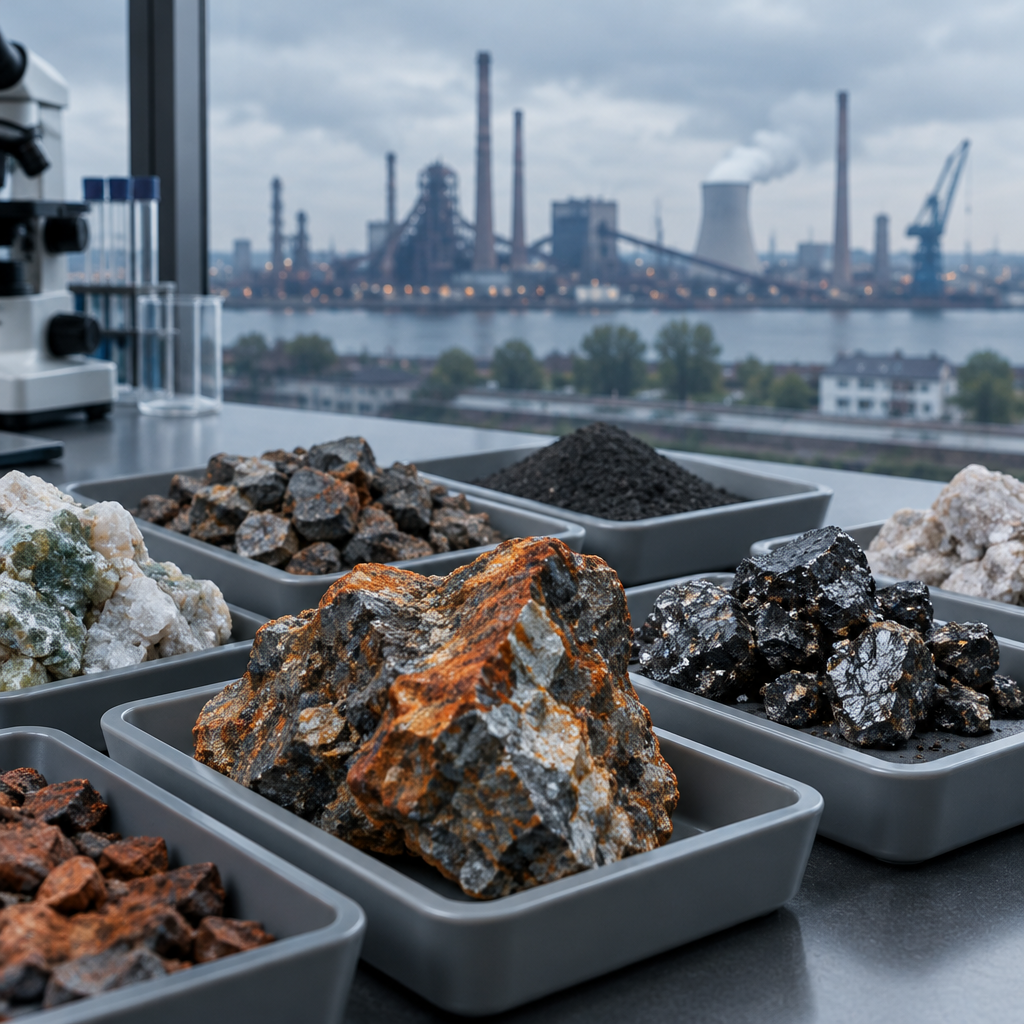
Merz Wants European Stockpiles of Critical Raw Materials, and He Did Not Say Who Pays
Speaking at an economic conference in Berlin on 5 November, German Chancellor Friedrich Merz called for strategic reserves of critical raw materials at European level, alongside supplier diversification and stronger recycling. He specified neither which minerals, nor volumes, nor financing, and the Commission is already building its own instrument.
German Chancellor Friedrich Merz proposed establishing strategic reserves of critical raw materials at European level, speaking at an economic conference in Berlin on 5 November. He argued for greater involvement of European authorities in protecting supply chains, alongside diversifying supplier countries and strengthening recycling and the circular economy.
The proposal responds to Europe's exposure to concentrated processing capacity, above all in China, which accounts for a dominant share of global refining of many strategic minerals and of rare earth processing. Those materials feed batteries, electric motors, semiconductors and the components on which advanced manufacturing depends.
The gap between the principle and the plan
Merz did not specify which minerals would be covered, how much material would be stored, or what the financing and management arrangements would be. That is not a minor omission. A reserve can be a physical stock held by a public agency, a contractual option over privately held inventory, a joint purchasing consortium with a buffer mandate, or a set of national obligations on large consumers. Each choice distributes cost and risk very differently.
Storage also solves only the interruption problem, not the dependence problem. A stockpile buys time during a shock. It does not create refining capacity, does not reduce the concentration of processing in a single jurisdiction, and does not by itself make European industry more competitive on input costs.
What Brussels is already doing
The German proposal lands on top of an existing pipeline rather than in empty space. On 9 October the Commission selected 46 new strategic projects across 16 member states under the Critical Raw Materials Regulation, covering extraction, processing and recycling, with streamlined permitting and facilitated access to finance.
The 2027 work programme adopted on 4 November goes further and commits the Commission to creating a European Corporation on Critical Raw Materials, an institutional vehicle with a mandate in supply security rather than a project list. Reuters reported in February that Italy, France and Germany were expected to take leading roles in the EU's stockpiling plan, which means Merz is now publicly backing something his officials have been negotiating for months.
There is an external benchmark too. The United States has moved its $12 billion strategic critical minerals reserve, known as Project Vault, into an operational phase. European industry associations have watched that programme and asked, reasonably, why European manufacturers should carry input risk that American competitors do not.
The sectors in the room
The exposure is concentrated. Automotive needs lithium, nickel, cobalt and rare earths for motors and magnets. Defence needs them for guidance systems, sensors and alloys. Semiconductor manufacturing depends on gallium, germanium and a long list of specialty materials. Aerospace and renewables, particularly wind, depend on permanent magnets where Chinese processing is close to a chokepoint.
This is also why the recycling emphasis matters politically. Secondary recovery from batteries, electronics and industrial equipment is the only supply source located entirely inside the EU, and it is the one that can be scaled with domestic policy rather than trade negotiation.
The questions that will decide it
Three tests will determine whether a European reserve becomes real.
The first is financing. A reserve is inventory, and inventory costs capital, storage and obsolescence. If the cost falls on member states, richer governments will build larger reserves and the Single Market will fragment. If it falls on the EU budget, it competes with the 2028 to 2034 Multiannual Financial Framework negotiations now entering their decisive phase.
The second is governance. A reserve that can be released only by unanimity will not be released in a crisis. A reserve that a single large member state controls will be used for that state's industry first.
The third is trade signalling. Stockpiling is a defensive measure that trading partners read as evidence of intent to decouple, and China has already shown willingness to restrict exports of gallium, germanium and rare earth processing technology in response to Western measures. The Commission is simultaneously preparing a new trade defence instrument that would allow it to restrict access to the EU market. Building a reserve while sharpening that instrument is a coherent strategy only if Europe has decided it can absorb the retaliation.
Merz's intervention makes an EU scheme more likely to happen and no more likely to be well designed. The design is where this will be won or lost.
Study Tips & Discussion
(0)Log in to join the discussion.
No comments yet — be the first to share your thoughts!