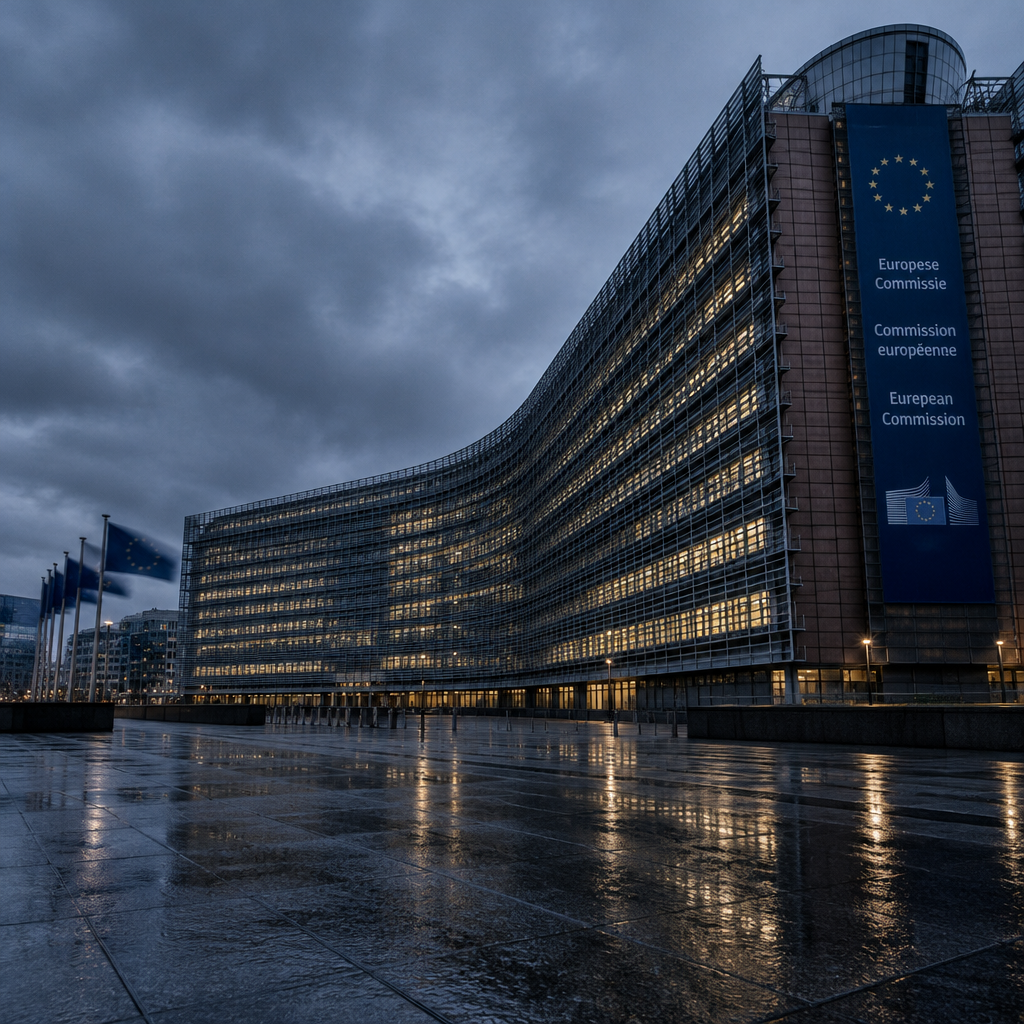
Le Pen Has a Second Target in Brussels: Kaja Kallas and the EU's Diplomatic Service
Marine Le Pen wants to dismantle or sharply reduce the European External Action Service if she wins the 2027 French presidency, according to four National Rally officials. The front-runner's plan would turn the EU's 100-plus delegations and 5,200 staff into collateral damage in her fight with Ursula von der Leyen.
Marine Le Pen has a second target in Brussels, and it is not Ursula von der Leyen. The French presidential front-runner wants to dismantle, or at the very least drastically reduce, the European External Action Service if she wins in 2027, according to four National Rally officials who spoke to POLITICO.
The party's argument is that the EU's diplomatic arm wastes money and duplicates the diplomacy of member states, and that its chief, Kaja Kallas, lacks the standing to be received anywhere that matters.
“The reality is that her usefulness is very limited, and she duplicates the diplomacy of member states,” said Charles-Henri Gallois, an adviser to National Rally president Jordan Bardella. “No one recognizes her legitimacy, particularly not the United States, nor China.”
Why the EEAS and not just the Commission
Le Pen has directed her sharpest attacks at the Commission, which the far right has long accused of exceeding its powers. But it is the EEAS that becomes collateral damage in a far-right presidency, partly because it is the softer target and partly because foreign policy is where the National Rally most wants to restore national discretion.
During a recent visit to Brussels, Le Pen said France would no longer accept that the Commission exercises diplomatic competences, “and even less military or intelligence competencies”. The National Rally's programme for government, in this reading, is not withdrawal from the EU but a deliberate hollowing of its central institutions.
The service she would be shrinking is not small. The EEAS has an annual budget close to €1 billion, employs more than 5,200 people worldwide and runs a network of over 100 delegations, staffed by national diplomats and Commission officials from units such as DG MENA. It is also mid-reform: Secretary-General Kajsa Ollongren is expected to present internal changes to staff later this month.
The division over Ukraine
The most consequential disagreement is not institutional but strategic. Kallas is one of Vladimir Putin's fiercest critics and a staunch supporter of Volodymyr Zelenskyy. Le Pen is pushing for an international peace conference to settle the war and argues that Europe has run out of money to give Kyiv.
“She has used very warrior-like language on Ukraine,” said National Rally MEP Jean-Paul Garraud. “We support Ukraine but if we expressed ourselves like that we would be in total war” with Russia.
The two positions are not reconcilable in a single EU line, which is why the institutional question matters more than it looks. Whoever controls the diplomatic service controls whose version of the Ukraine file becomes the European one.
The money fight underneath
The offensive against the EEAS is tied to a budget fight. Last month the National Rally unveiled plans for an €11 billion cut to France's EU contribution for 2027, which is currently expected to total roughly €30 billion. France cannot unilaterally cut the EEAS budget, but the party believes it can assemble allies: Italy, Spain's Vox, which could end up governing with the centre-right after this month's election, and Andrej Babiš's Czech Republic.
It arrives at a moment when the service is already being squeezed from the other side. France and Germany have jointly pitched plans to reform the EEAS, arguing it lacks the policy tools to influence foreign relations and proposing to integrate it with the Commission, which has the larger budget and controls trade and technology policy. Commission officials have internally simulated cutting the bloc's Global Europe budget, worth €200 billion in the last long-term framework, by as much as 40%.
The UN Secretary-General Antonio Guterres has written to the heads of the Commission and Council urging them to preserve development funding, which is the clearest signal that the cuts under discussion are large enough to be seen from New York.
“If Marine Le Pen becomes president of France, she will quickly realise that France is a medium-sized country on the global stage,” said Irish Renew MEP Barry Andrews, who chairs the European Parliament's development committee. “Without the collective power of Europe, France has no chance going up against the US or China alone.”
The EEAS itself did not pretend the criticism was technocratic. “Across Europe, the far right is against the very idea of European cooperation,” a spokesperson said. “EU diplomacy defends European interests, including those of France. The EU's global delegation network is a major strategic asset.”
The numbers that make this real
POLITICO's Poll of Polls puts Le Pen on 34% in the first round, well ahead of Jean-Luc Mélenchon on 17% and the centre-right's Edouard Philippe on 16%. Polls also suggest she would beat most potential rivals in a runoff.
That is why a service nobody outside Brussels could name a year ago is now the subject of a detailed demolition plan. The 2027 election is no longer a hypothetical for EU institutional planning. It is the scenario being priced in.
Study Tips & Discussion
(0)Log in to join the discussion.
No comments yet — be the first to share your thoughts!
More in EU Institutions
Related Articles

The EU Signs Off Its Last Normal Budget: €199.7 Billion, and a Defence Line of €3.1 Billion
7 min read

Tomorrow's EU Agenda: Dublin Summit Focuses on AI and Security — 13/11/2026
3 min read

Tomorrow's EU Agenda: Ukraine Security and Strategic Competitiveness — 12/11/2026
3 min read