Six Dead in Kraków: A Gunman, a Far-Right Ideology and a Square Full of Tourists
A 25-year-old Polish man drove into Kraków's main market square on Saturday afternoon and opened fire with an automatic weapon, killing six people including a British citizen and wounding 16. Three more bodies, likely family members, were found at his home. The interior minister says he held 'ultra-nationalistic' views. Poland begins two days of mourning.
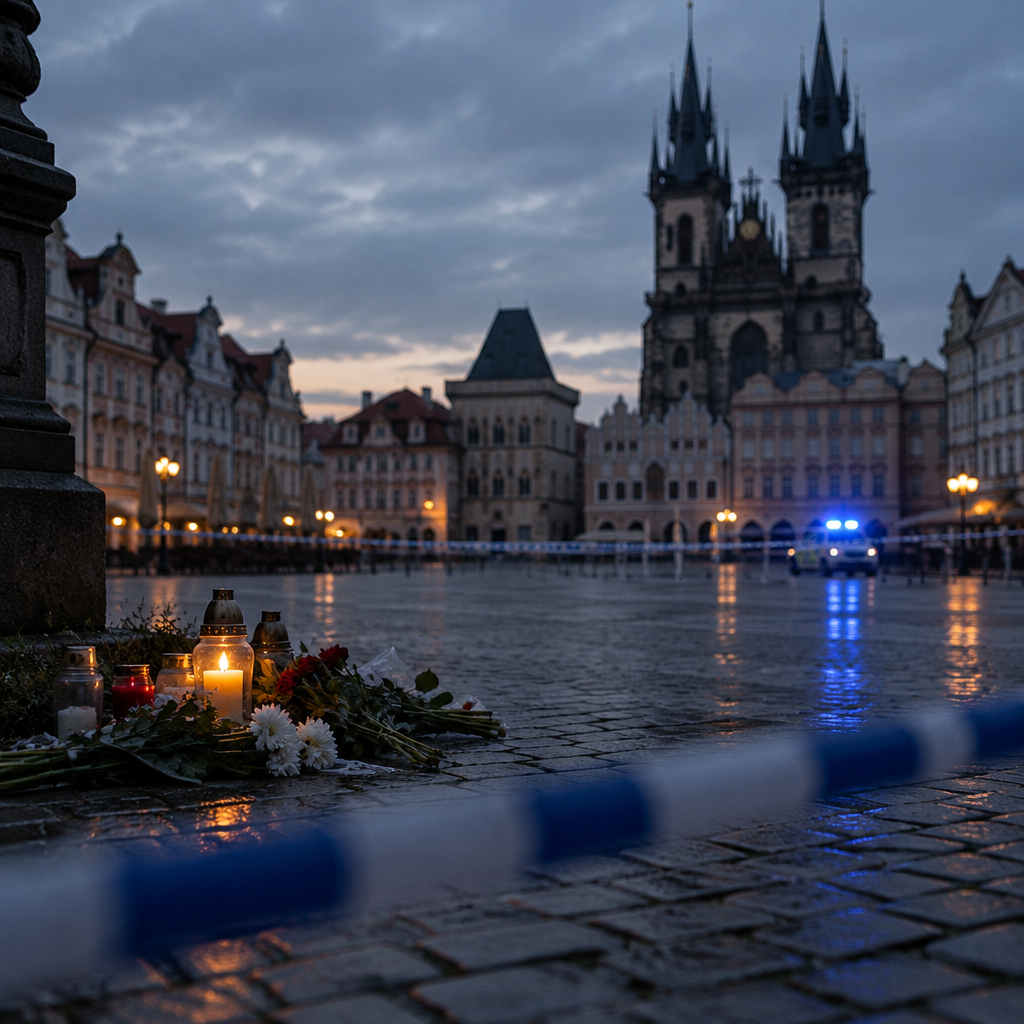
A gunman killed six people and wounded 16 in the main market square of Kraków shortly after 3pm on Saturday, in an attack Poland's defence minister described as an act of terror on the city, and which the interior minister linked to far-right ideology.
The suspect, a 25-year-old Polish citizen, drove into the Rynek Główny, the vast medieval square at the centre of Poland's second city, and opened fire with an automatic weapon. A tram driver passing nearby reported that his cabin window had been shot out by a man firing from a moving car. Police arrested the attacker after an exchange of fire in which two officers were wounded, one of them shot three times and in a serious condition.
Who died
Four women and two men were killed, according to Polish police, among them a British citizen. Three of the victims were Polish women. The foreign nationals among the wounded came from Britain, Austria, Germany, Portugal and Russia, a government spokesperson said.
Late on Saturday night Prime Minister Donald Tusk said two more women and one man had been found dead at the suspect's home, most likely members of his family. That disclosure changed the shape of the case: a public mass shooting preceded, apparently, by a domestic one.
Government spokesperson Adam Szłapka wrote on X that the event had "shaken all of Poland". President Karol Nawrocki said he was deeply concerned. Justice Minister Waldemar Żurek promised the perpetrator would be held fully accountable. National mourning was declared for Sunday and Monday.
What the government says about motive
Interior Minister Marcin Kierwiński told a press conference that the suspect was fascinated with far-right ideologies and held "very radical" and "ultra-nationalistic" views. Defence Minister Władysław Kosiniak-Kamysz called the shooting an act of terror on the people of Kraków.
Those are two different legal and political framings, and Polish authorities will have to choose. Terrorist designation unlocks a different set of investigative powers, prosecutorial routes and, eventually, a different conversation about prevention. Criminal insanity or lone grievance keeps the case contained and the policy response small.
The gun question Poland has been avoiding
Poland has militarised its society deliberately since 2022, with voluntary defence training, a larger territorial defence force and a broad political consensus that an armed population is part of deterrence. Legally held firearms passed one million for the first time this year, and the country issued a record 50,700 new permits in 2025. Active permits are roughly double the 2015 figure.
None of that caused Saturday's attack, and the weapon's provenance has not been established. But it does mean the Polish debate that follows will not be the usual European one about restricting access. It will be about screening, about who in a rapidly arming society shows signs of extremism, and about whether a permit system built for hunters and sport shooters can see a radicalisation process happening in front of it.
A city built for crowds
Kraków receives around 15 million visitors a year, most of whom pass through the market square, a UNESCO site ringed by cafés and church towers. Saturday was mild for November. The square was full.
That has consequences beyond Poland. The attack lands in the middle of a European autumn already defined by hostile action against open public space: a coordinated bomb-threat campaign that emptied Irish newsrooms and diverted more than 22 flights in the past week, cyber intrusions into supermarket refrigeration systems, and now a mass shooting at the tourist heart of a major EU city.
Poland sits on the eastern edge of that threat picture and has spent three years warning that hybrid attacks would migrate from infrastructure to people. It is also the country whose hospitals have treated the war next door and whose airports have been the logistics spine for Western aid to Ukraine. Saturday's attack was not hybrid warfare in any proven sense. It was a radicalised young man with a gun.
But the political question that follows will not stay inside Poland.
Study Tips & Discussion
(0)Log in to join the discussion.
No comments yet — be the first to share your thoughts!