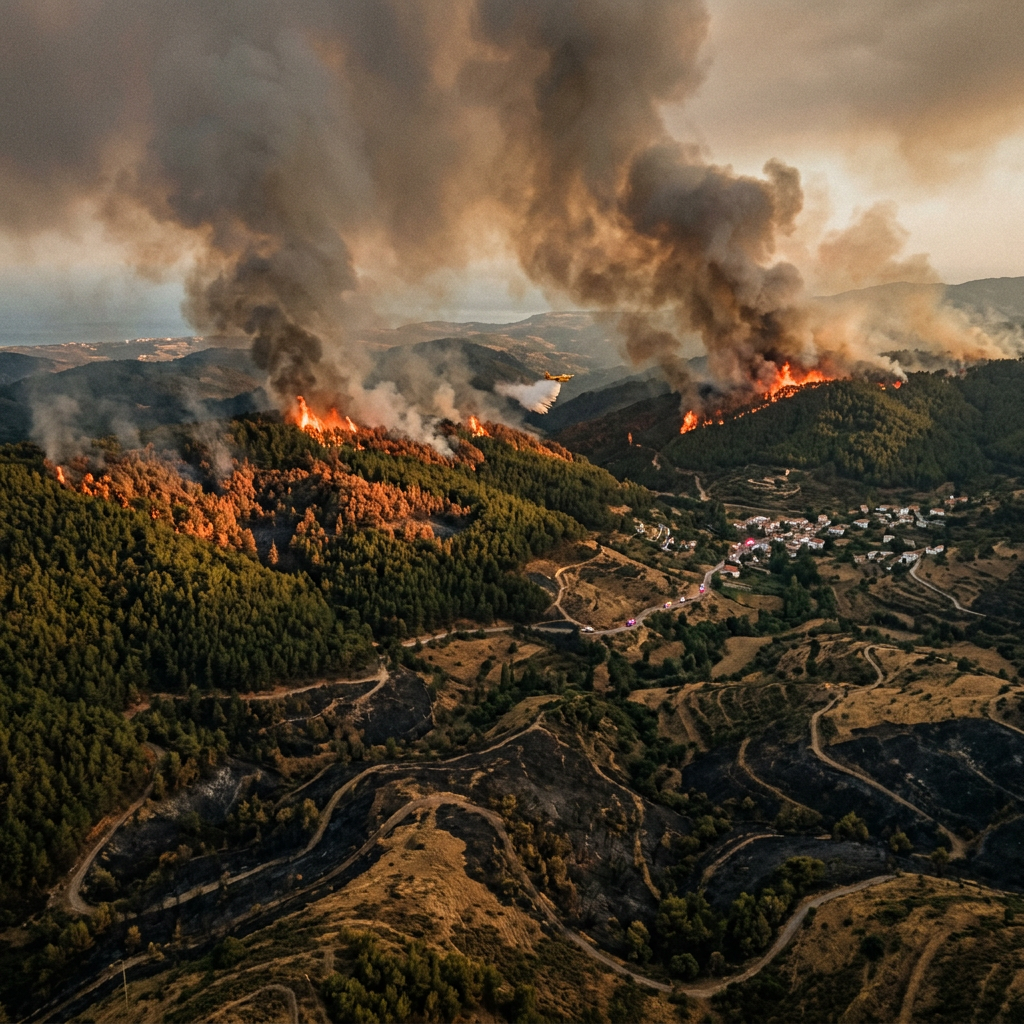
2025's Wildfire Season Was Europe's Worst Ever — And 2026 Is Already Tracking Higher
2025 saw 2.7 million acres of European forests burn — the worst year on record. Spring 2026 is already showing alarming trends, suggesting this year could be worse.
In 2025, wildfires across the European Union burned over 2.7 million acres — 1.1 million hectares — the highest total on record. That record has stood for exactly four months.
Spring 2026 is already showing elevated fire risk across southern Europe, and wildfire tracking data suggests that unless spring rainfall is significant, this year will exceed last year's apocalyptic total.
The Pattern
This is not a one-year anomaly. The data shows a clear trend: each year surpasses the previous record. 2024 was a record. 2025 shattered it. 2026 is tracking to shatter 2025.
The Mediterranean region is the epicentre: Greece, Spain, Portugal, Italy, and southern France have all seen fire seasons expand by months. What used to be contained to July-August now starts in June and extends into September.
The Climate Connection
Rising temperatures + delayed rainfall = extended fire seasons. Europe's average temperatures have risen 2°C above pre-industrial levels. Soil moisture deficits are persistent. The conditions for catastrophic fire are now structural, not exceptional.
This is not speculation. It is observable in the data year after year.
The Knock-On Effects
Wildfires destroy infrastructure, displace populations, and kill people. They also destroy forests that function as carbon sinks, accelerating climate change itself — a feedback loop that is already in motion.
Economically, the costs are staggering. Rebuilding, emergency response, agricultural losses, tourism disruption — in some regions, wildfire costs now exceed regional GDP growth.
And politically, Europe's inability to prevent or mitigate these disasters is becoming a legitimacy crisis for governments that have committed to climate action but cannot deliver observable results.
When the data shows the same pattern year after year, it is no longer a crisis. It is a condition. And a condition requires not emergency response but systemic change.
Study Tips & Discussion
(0)Log in to join the discussion.
No comments yet — be the first to share your thoughts!