Europe Finally Names Its Team. The Hard Part Starts Monday.
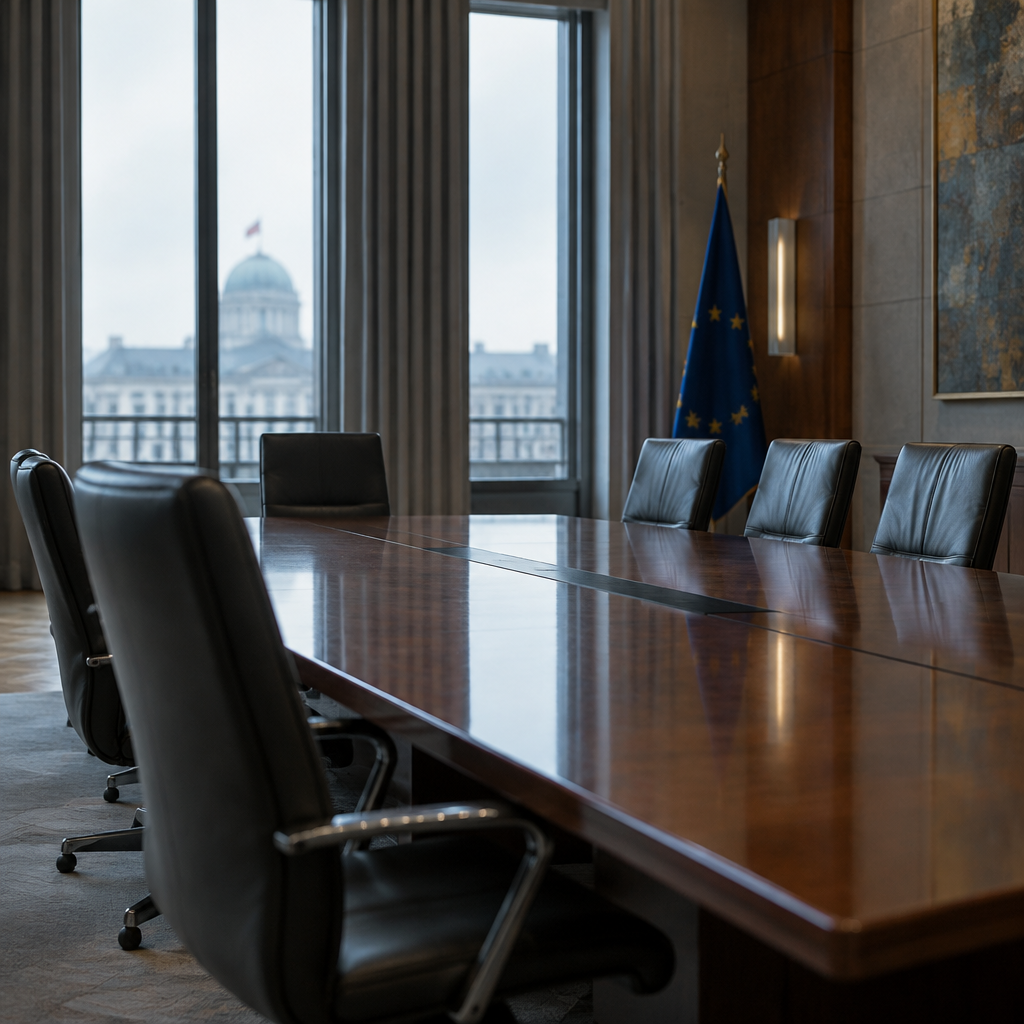
EU leaders agreed in Dublin on Friday that Europe will be represented in Ukraine peace talks by the EU institutions plus France, Germany, Italy, Poland and the UK, with national security advisers doing the negotiating. It ends a week of open disagreement about who speaks for Europe. It settles very little about what Europe will say.
European leaders meeting informally in Dublin on Friday agreed that Europe's representatives in future Ukraine peace negotiations will be the EU institutions together with the E5: France, Germany, Italy, Poland and the United Kingdom. The national security advisers of the five capitals are expected to do the negotiating, alongside the Council and the Commission.
European Council President António Costa announced the formula at his closing press conference. "Today the Leaders agreed that our European Team for the negotiations on peace in Ukraine is the European Union institutions and the E5," he said, adding that the Union would "support Ukraine and safeguard our interests." Polish Prime Minister Donald Tusk, whose country had pushed hardest for a seat, put it more plainly: "This is our time."
What actually changed
Until Thursday there was no European seat at all. US negotiators Steve Witkoff and Jared Kushner told European officials that Vladimir Putin had accepted European participation in a future round, and the question immediately became which Europeans. Estonia argued for Costa and foreign policy chief Kaja Kallas as the single European voice. Chancellor Friedrich Merz pushed for the E3 of France, Germany and Poland. Others wanted to attend in person. Friday's agreement is the compromise that survived: a group large enough that nobody is excluded and structured enough that Washington has a phone number.
It is a genuine decision, taken by leaders rather than officials, and it resolves the question that hung over the summit's first day. It is also the weakest form of the answer available. Seven parties, five of them sovereign states with their own bilateral channels to Washington, is not a negotiating position. It is a coordination mechanism that has yet to be coordinated.
What is not settled
The mandate, for a start. Nothing published on Friday says what the European team is authorised to concede or to promise, whether it can discuss sanctions relief, and whether it sits at the table or in an adjacent room while the United States and Russia talk. Nor is it clear who leads the European side within the format, or how the E5 advisers relate to Costa and to Kallas, who holds the Union's foreign policy brief and has been the most visible European voice on Russia since the war began.
The Russian condition is the larger obstacle. Putin has said that any deployment of European troops to Ukraine would mean a resumption of the war. European capitals have spent the autumn discussing precisely such a deployment as part of a security guarantee. So the team arrives at the table with a demand it cannot drop, from a counterpart who has pre-emptively rejected it.
There is also a calendar problem. Merz has convened the Coalition of the Willing in Berlin for Thursday 19 November, four days before EU foreign ministers are due to adopt the twenty-second sanctions package. Europe will therefore be designing its leverage and its negotiating position in the same week, in two different rooms, with two different sets of participants.
The summit that was meant to be about something else
Dublin was convened to discuss artificial intelligence. Leaders did hold what Costa described as their first in-depth discussion on the subject on Friday morning, and they heard from Geoffrey Hinton, who has spent the past two years warning that advanced systems could escape human control. "AI should be for the benefit rather than the ruination of mankind," Taoiseach Micheál Martin said afterwards. No decisions were taken and no conclusions were published.
By mid-afternoon the agenda had been overtaken. That is now the pattern of European Council meetings: the prepared topic gets an hour and the emergency gets the rest. The AI discussion will resume at the December summit, by which time the same thing may happen again.
What to watch
The first test is whether the E5 advisers and the institutions produce a single written position before the next round of talks. The second is whether Kallas attends in her own right or is represented by an official. The third is Berlin on 19 November, where the countries that will actually have to fund and staff any guarantee will say in public what they have been saying in private since the summer.
Sources
- ↗European Council, 13 November 2026: Remarks by President António Costa at the press conference following the informal meeting of Heads of State or Government
- ↗European Council: informal meeting of Heads of State or Government, Dublin, 13 November 2026
- ↗European Parliament: plenary and AFET documentation on Ukraine and European security, November 2026
Study Tips & Discussion
(0)Log in to join the discussion.
No comments yet — be the first to share your thoughts!
More in Geopolitics
Related Articles
Brussels Is Writing Its 22nd Russia Package, and This Time the Trigger Is Arson and Drones
6 min read
Europe Has a Seat at the Table Now. It Still Cannot Agree Who Sits In It
7 min read
Kallas Tells Washington What Brussels Has Never Said Out Loud: 'We Will Not Implement It'
7 min read