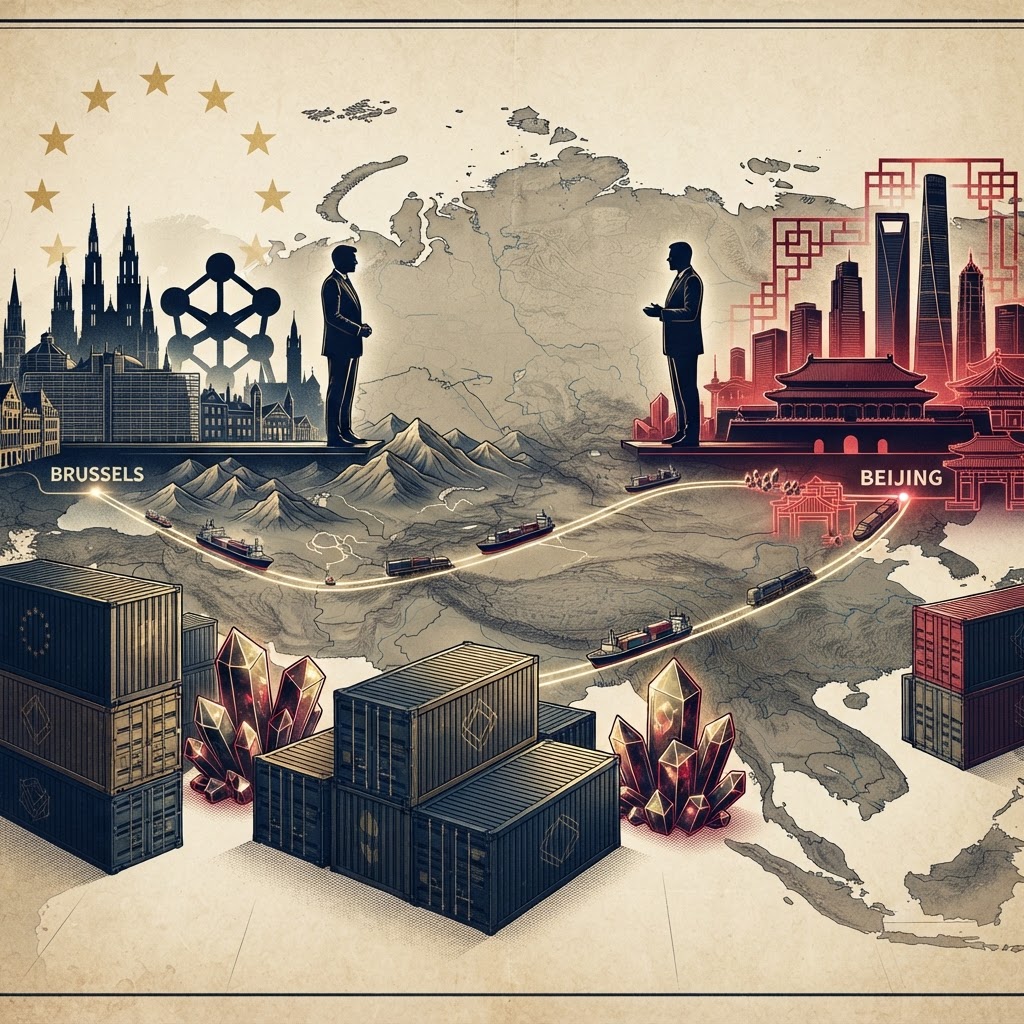
EU-China Talks Open as Brussels Seeks Trade Rebalancing
Trade Commissioner Maroš Šefčovič arrived in Beijing for talks focused on a daily EU trade deficit exceeding €1 billion and Chinese restrictions on critical-mineral exports. The negotiations begin as Parliament presses for a more assertive China policy.
European Trade Commissioner Maroš Šefčovič arrived in Beijing on 7 October ahead of meetings with Chinese Commerce Minister Wang Wentao on Thursday and Friday. The talks are aimed at narrowing an EU trade deficit with China that Brussels says now exceeds €1 billion a day, while addressing restrictions on exports of rare earths and other critical minerals.
Negotiations under pressure
The visit follows months of exchanges and comes as European officials seek tangible results before the next meeting of EU leaders. China has rejected calls for voluntary limits on hybrid-car exports, according to reporting cited by Al Jazeera, while EU officials have reportedly explored a unilateral cap. That remains a reported option, not an agreed measure.
Political pressure is building in parallel. On 7 October, the European Parliament adopted a non-binding recommendation calling for a more assertive and principled approach to China, including stronger economic reciprocity and de-risking in strategic sectors. French President Emmanuel Macron and German Chancellor Friedrich Merz have also urged the EU to prepare a rapid-response instrument for economic coercion, to be discussed by leaders at an upcoming summit.
What is at stake
For the EU, the immediate test is whether dialogue can produce measurable movement on market access and supply-chain vulnerabilities before trade disputes intensify. Rare earths are essential to a range of industrial and clean-technology supply chains, while the rise of Chinese vehicle exports has sharpened concerns about competition and industrial capacity in Europe.
Beijing, for its part, has warned against protectionist measures and argues that European concerns about overcapacity are being used to restrict Chinese firms. The meetings are therefore both a technical trade negotiation and a test of the broader EU-China relationship.
Why it matters: The EU is attempting to pair negotiation with credible leverage. The outcome will show whether member states can agree on a common position and whether Beijing is prepared to offer concrete concessions.
What to watch: Any joint readout after the meetings, progress on critical-mineral exports, and the European Council’s response to proposals for new trade-defence tools.
Study Tips & Discussion
(0)Log in to join the discussion.
No comments yet — be the first to share your thoughts!