Brussels Picks a Side: Commission Backs the Sejm Over Poland's President
The Commission has said in terms that appointing judges to Poland's Constitutional Tribunal is parliament's constitutional power, and cited ECHR interim measures against Warsaw. It is an unusual intervention in a dispute between a member state's own institutions.
The European Commission has reaffirmed the Polish parliament's right to appoint judges to the Constitutional Tribunal, in the most direct intervention yet in the standoff that has paralysed Warsaw since Friday.
"The appointment of eight new members of the Constitutional Tribunal lies within the constitutional power of the Sejm," a Commission spokesperson told the Kyiv Independent on Sunday. The spokesperson also noted that the European Court of Human Rights "issued interim measures obliging the competent Polish authorities to refrain from hindering the taking up and exercise of judicial duties by judges appointed by the Sejm."
That is not neutral language. It is a legal position, and it lands on one side.
How the crisis broke
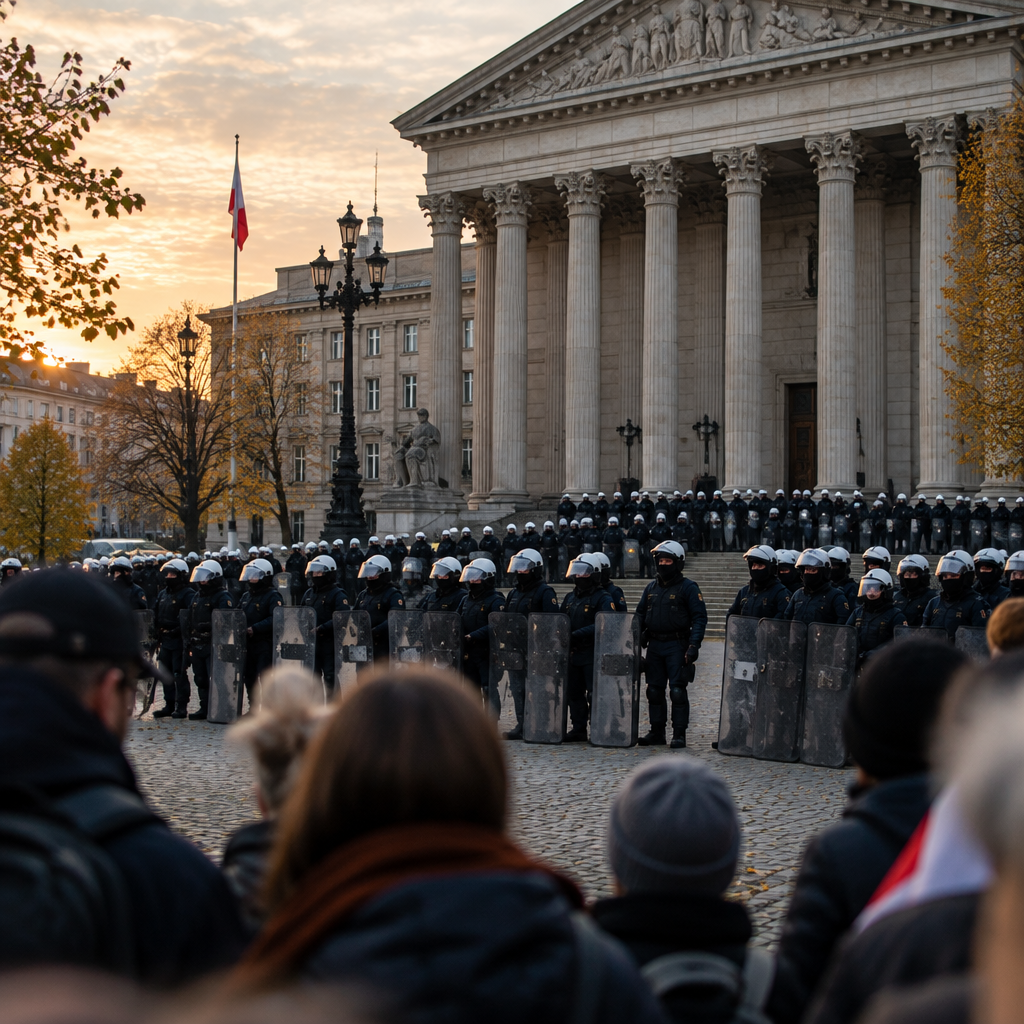
The dispute has been building since President Karol Nawrocki refused to administer the oath to newly appointed judges, turning what is normally a procedural formality into an indefinite block on them taking office. On Friday, the most senior of the new appointees simply took charge of the Tribunal. Riot police formed a cordon outside the building. The Tribunal's president, Bogdan Święczkowski, was prevented from entering the court he leads. The court called it a coup d'état.
Nawrocki summoned party leaders for crisis talks on Saturday. No breakthrough was reported.
The political war behind the legal one
Prime Minister Donald Tusk accused Nawrocki of "opting for a forceful confrontation" and called on him to recognise the judges "lawfully elected." Foreign Minister Radosław Sikorski framed it as a refusal to accept a democratic outcome: "Our populist opposition is unfortunately refusing to accept its loss of control over the Tribunal. The democratically elected government will continue to uphold the constitution."
Jarosław Kaczyński, the PiS leader who engineered the original politicisation of the court, went considerably further: "From today, Poland is becoming a police state, and from there it's a straight path to authoritarianism, and then to totalitarianism."
Both sides are using the vocabulary of democratic defence against each other. That is what makes it unresolvable inside Poland.
Why this was always coming
The backdrop is a decade of litigation. The previous Law and Justice government placed the judiciary under political control, which prompted the Commission to launch a legal procedure against Warsaw in 2017 and eventually to withhold recovery funding. Tusk's coalition was elected on a promise to reverse that, and judicial restoration has been its central project. Nawrocki, who came from PiS, was elected president in 2025 and has used his office to slow it down.
The result is a constitutional order where two legitimately elected authorities each claim to be defending the constitution from the other, and neither can be overruled domestically.
What Brussels actually said, and what it did not
The Commission did not criticise the government's use of police, did not call for de-escalation from both sides, and did not question whether suspending the Tribunal's president was proportionate. It simply affirmed that the Sejm may appoint, and that Strasbourg has ordered Polish authorities not to obstruct those appointees.
This is a meaningful shift. For years the Commission's rule of law toolkit was built around process: Article 7 hearings, conditionality regulations, annual reports. All of it assumes a government to negotiate with. Here the Commission has effectively identified which institution it considers constitutionally legitimate, in a dispute where a co-equal head of state disagrees.
The costs
There are three. The first is that the Commission has made itself a participant in a Polish election campaign. Bloomberg described the court clash as the start of "Poland's brutal election campaign," and Tusk will now campaign as the government Brussels backs, which cuts both ways in a country where sovereignty is a live political currency.
The second is credibility in enlargement. The EU is currently telling Montenegro, Serbia, Kosovo and Ukraine to fix their courts and courts' independence in order to join. It is harder to deliver that lecture from a Union where the Commission has just endorsed one branch of government over another in its fifth-largest member state.
The third is time. Poland holds the presidency of the Council in the first half of 2027 in the current rotation, and a government locked in a constitutional standoff is a government with limited bandwidth for the files it is meant to chair.
The legal question will be settled in Warsaw or Luxembourg. The political question, whether the EU can be a referee in its members' constitutional disputes without becoming a player, has just been answered badly.
Study Tips & Discussion
(0)Log in to join the discussion.
No comments yet — be the first to share your thoughts!
More in EU Institutions
Related Articles

The EU Signs Off Its Last Normal Budget: €199.7 Billion, and a Defence Line of €3.1 Billion
7 min read

Tomorrow's EU Agenda: Dublin Summit Focuses on AI and Security — 13/11/2026
3 min read
Tomorrow's EU Agenda: Ukraine Security and Strategic Competitiveness — 12/11/2026
3 min read